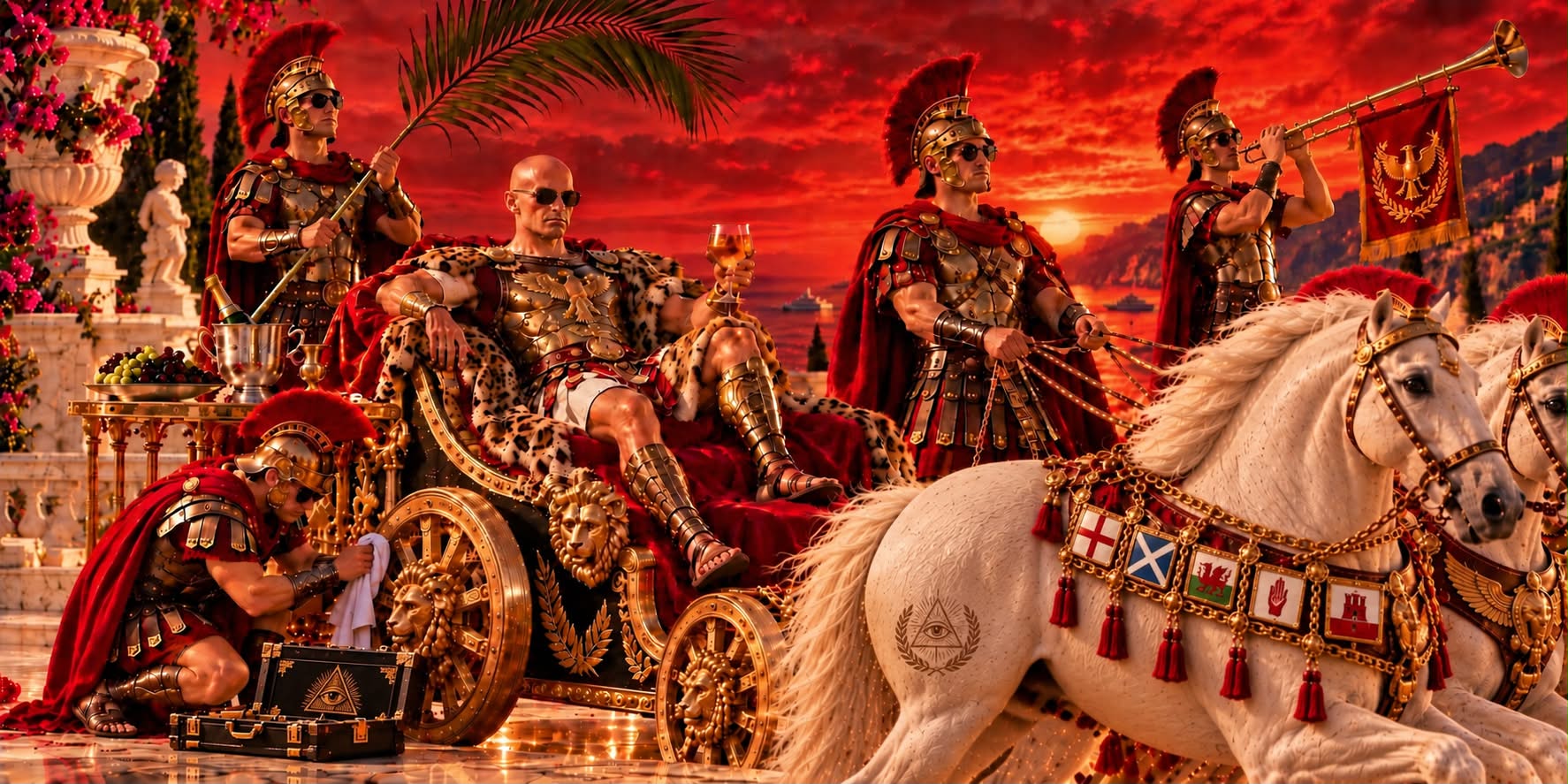
THE EMPIRE, LATE PERIOD
Historians remain divided over the precise moment things got out of hand.
Rome did not fall in a day.
It had borders to defend, armies to maintain, distant territories to support, political factions to appease, demographic change to manage, and an increasingly expensive state to keep functioning.
At home, the machinery became less reliable.
None of which meant the procession had to stop.
There were still ceremonies. There were still statues. There were still men explaining that everything was proceeding broadly according to plan.
This is the peculiar thing about decline. From inside it, it can look remarkably like normal life.
The standards are flying. The horses are immaculate. The emperor has a drink.
Rome is still Rome.
Until it isn’t.
Or until the local council takes the standards down.
Articles
THE RECORD
What follows is a collection of essays, arguments, observations, dreams and other evidence of questionable reliability.
Commentary, essays, satire, dreams, descriptive prose and occasional poetry.
Politics, institutions, history, people, places, dreams and whatever else seems worth recording.
Some are observations. Some are arguments. Some are stories. Some happened. Some probably didn’t. Some are probably inadvisable.
All are presented for the record.
Published September 2026 | Author: The Unreliable Witness
Britain’s New Religion
Britain, we are repeatedly told, is becoming less religious. The churches are emptier. The clergy are older. The great theological disputes that once divided families, towns and occasionally kingdoms have largely retreated into history books, Sunday-morning radio and the more argumentative corners of the internet. A sizeable part of the population can now live an entire adult life without being required to distinguish between Leviticus and Ecclesiastes, and the average office is considerably more likely to contain a mindfulness room than a chapel.
And yet religion itself appears to be flourishing. It has simply changed premises. Its new churches have swipe cards and glass doors. Its clergy carry laptops. Its commandments arrive by email. Its feast days are already entered into Outlook. Its doctrine is distributed in PDF format, usually shortly before somebody from Human Resources explains that completion of the accompanying module is mandatory.
Nobody calls any of this religion, obviously. That would be ridiculous. These are values. There are policies concerning the values, guidance explaining the policies, training concerning the guidance, consultants available to explain the training and, somewhere deep within the organisation, a person whose job appears to involve explaining why everyone else has misunderstood the values.
This is entirely different from theology.
The PowerPoint has transitions.
The curious thing is that the story begins with principles so reasonable, and in many cases so honourable, that almost nobody should wish to abandon them. People should be treated equally before the law. Minorities should not be persecuted. Employers should not discriminate unfairly. Individuals should be protected from harassment, intimidation and abuse. People should be able to worship, speak, love, work and live without being treated as lesser citizens because of characteristics that have nothing to do with their worth as human beings. The state should respect freedom of conscience and belief. These are not absurd ideas. They are among the achievements of the liberal settlement, purchased through arguments and struggles that should not be casually forgotten merely because somebody has subsequently produced an irritating training course.
But principles have social lives. Rights become values. Values require implementation. Implementation requires policy. Policy requires monitoring. Monitoring requires reporting. Reporting requires evidence. Evidence requires measurement. Measurement eventually requires somebody with a laminated lanyard, a spreadsheet and a budget.
Somewhere along that journey, almost imperceptibly, a framework originally designed to regulate conduct can begin acquiring opinions about belief.
Equality becomes inclusion. Inclusion becomes belonging. Belonging acquires an approved vocabulary. Safeguarding extends beyond preventing tangible harm and begins to encompass increasingly sophisticated theories about what harm might mean. Concepts such as lived experience, unconscious bias, structural privilege, allyship, psychological safety and social justice enter the administrative language. Some describe genuine phenomena. Some may be useful attempts to understand difficult human experiences. Others are contested ideas about which reasonable people can disagree. The interesting question is not whether every one of these concepts is right or wrong. It is what happens when the collection begins to function as a moral system while continuing to present itself as administration.
At that point the institution is no longer merely administering law. It may also be administering virtue.
Traditional religion has at least one advantage in this respect: it generally admits what it is. A church tells you that it possesses teachings. It presents scripture, doctrine, tradition and moral claims and invites, encourages or occasionally insists that you believe them. The building may even have a large object attached to the roof giving some indication of the business being conducted inside. You are broadly aware that you have entered the religion trade.
The modern institution is more subtle. It has no doctrines. It has best practice. It has no commandments. It has community standards. It has no sins. It has inappropriate behaviour, harmful language and problematic attitudes. It has no theologians. It has policy specialists. There is no catechism, merely a 47-page guidance document, revised following stakeholder consultation and available in accessible formats.
This distinction turns out to be enormously useful, because beliefs presented as beliefs can be challenged. Administrative facts are more difficult. If somebody tells you that a moral proposition is their conviction, you may reply that you disagree. If precisely the same proposition appears inside a safeguarding framework, disagreement can begin to look less like philosophy and more like risk.
But institutional authority is not epistemic authority. An organisation may possess the legitimate power to adopt a policy without possessing the power to make every proposition contained within that policy true. A committee can approve a definition. A regulator can publish guidance. A department can adopt a framework. None of these acts settles the underlying philosophical argument merely by performing an administrative one.
This is an easy distinction to lose because institutions are exceptionally good at converting uncertainty into paperwork. Once a contested proposition has acquired a policy number, an implementation plan and a mandatory training module, it begins to acquire the appearance of something that has already been decided in a much deeper sense.
It has not necessarily become true.
It has become official.
Risk, naturally, must be managed. Management requires policy. Policy requires compliance. Compliance requires monitoring. Monitoring identifies further risk.
And so the wheel turns, although naturally there is now a governance framework for the wheel.
Nobody has established a state religion. No Act of Parliament requires citizens to profess a creed. There has been no coronation of an Archbishop of Inclusion. Nobody has marched upon Westminster carrying tablets of stone inscribed with the approved terminology.
The genius of the modern state was not to establish a religion. It was to establish a compliance framework and allow the religion to emerge inside it.
Every functioning moral order eventually discovers heresy. Christianity had apostasy and blasphemy. Modern institutions prefer a gentler vocabulary: inappropriate, exclusionary, offensive, unsafe, harmful, problematic. These words are not meaningless. An employer genuinely needs to deal with harassment. A school needs rules. A hospital needs to protect patients. A public service cannot function if staff are permitted to abuse the people they serve. Civility is not oppression and equal treatment is not ideological conformity.
The difficulty begins when the boundary moves from regulating conduct to regulating the beliefs thought to lie behind it. A person may obey the law, treat colleagues with courtesy, refuse to discriminate and perform a job perfectly well while privately rejecting some of the philosophical propositions that have accumulated around identity, language or social justice. Liberalism once had a reasonably straightforward answer to this problem: conduct may be regulated, but conscience belongs to the individual.
Modern inclusion can sometimes ask for something more ambitious than tolerance. It can ask for affirmation.
The distinction is small enough to disappear inside a policy document and large enough to transform the relationship between citizen and institution. “You must tolerate your neighbour” belongs to an old liberal tradition. “You must understand your neighbour through the approved moral vocabulary” is a rather different proposition. The first establishes rules for living peacefully alongside people whose beliefs may be profoundly different from your own. The second begins to prescribe the intellectual terms upon which that coexistence is permitted.
And here the new religion develops one of its most elegant paradoxes: a system created partly to protect freedom of belief must eventually decide how much disbelief it is prepared to tolerate.
A mature moral system also requires some account of sin, or at least of moral implication. It must explain how decent people who intend no harm can nevertheless participate in injustice. Christianity developed original sin. Modern institutional morality speaks instead of unconscious bias, structural privilege, systemic discrimination and inherited advantage.
The concepts are not equivalent, and pretending they are would make the joke simpler but the argument poorer. Structural inequalities can exist. Human beings plainly carry assumptions they do not recognise. Institutions can perpetuate unfairness without convening secret meetings at which everybody agrees to be wicked. The religious resemblance lies not in claiming that these ideas are false, but in observing their social function. Moral implication can precede conscious intention.
A person may participate in an unjust structure without intending injustice. A person may possess a bias without knowing it. Indeed, the inability to perceive the bias may itself become part of the explanation for its persistence. The problem therefore cannot always be solved merely by instructing people not to behave badly. Something deeper is required.
Examination of conscience follows. There are reflection exercises, awareness programmes, privilege assessments and commitments to allyship. Participants are encouraged to listen, learn, acknowledge, reconsider and reflect upon the assumptions they may unknowingly carry.
Eventually there is something resembling confession: I recognise my privilege; I acknowledge my unconscious biases; I need to listen and learn.
Redemption is available, although curiously provisional. There is rarely a moment at which the institution announces that sufficient reflection has occurred, moral development is complete and the employee may return permanently to a state of grace.
Christianity offered absolution. The compliance department scheduled another training session.
A sophisticated faith also needs interpreters, because doctrine becomes difficult once it encounters reality. Somebody must decide which terms are appropriate, which accommodation is reasonable, which competing right takes precedence, which behaviour creates risk, which historical language now requires reconsideration and what “best practice” happens to mean this Thursday.
Thus emerges something resembling a priesthood. They do not normally wear robes. They work in HR, policy, diversity, safeguarding, regulation, professional standards and consultancy. Most are ordinary people doing necessary work, often confronting genuinely difficult human problems. The religious comparison becomes interesting not because their work exists, but when interpretative authority begins accumulating around it.
Ordinary people increasingly require specialists to explain not simply what the law requires, but what the institution believes the law means morally. Doctrine becomes professionalised, and professionalisation has a remarkable survival instinct. Once an organisation establishes a department to identify a particular category of risk, that department is unlikely to announce at the end of the financial year that the problem has been comprehensively solved, the guidance can be withdrawn and everybody involved may now be made redundant.
Instead, the taxonomy improves. New categories emerge. Guidance expands. Assessments become more sophisticated. Training becomes recurrent. Compliance generates evidence demonstrating the continuing need for compliance.
The medieval Church sold indulgences. The modern institution sells consultancy days.
The comparison is not exact.
The invoice is considerably better formatted.
There is, however, a darker historical parallel. Religious institutions did not merely provide Britain with ritual, hierarchy and moral certainty. Some also demonstrated the danger that arises when an institution becomes more concerned with preserving its authority than questioning itself. The history of child sexual abuse provides the most terrible example: allegations kept inside institutions, reputations protected, warnings disregarded and victims unheard. Britain eventually discovered that secular institutions were not immune to the same pathology. Local authorities, police forces and other public bodies have themselves been found to have failed children over prolonged periods. The theology may change. The institutional instinct to protect the institution can remain remarkably familiar.
No religion survives through doctrine alone. Belief has to be performed. Communities require rituals through which they remind themselves what they believe and, perhaps more importantly, demonstrate to one another that they continue to believe it. The modern institution has become remarkably accomplished at this.
There are awareness days, awareness weeks and awareness months. Leaders issue statements. Logos temporarily change. Staff signatures acquire symbols. Training is completed. Commitments are reaffirmed. Internal campaigns appear. Photographs are taken. The annual moral calendar advances with an efficiency the medieval Church might reasonably have envied.
None of this is inherently sinister. Societies have always commemorated what they regard as important. Remembrance itself can be an act of dignity. Public recognition can tell people who have historically been ignored that they are finally being seen. The revealing question begins when the calendar ceases merely to commemorate and becomes a map of institutional virtue.
Some causes receive a month. Others receive a week. Some receive branded communications from the chief executive, banners in the reception area and a special footer beneath the corporate email signature. Others pass almost unnoticed. Time, like money, is finite, and no institution can officially commemorate everything. Choices therefore have to be made.
The calendar quietly establishes a hierarchy of moral attention.
No theologian is required.
The Outlook calendar has become the Book of Common Prayer.
Then there are the icons: flags, ribbons, badges, lanyards, logos and additions to email signatures capable of communicating solidarity and institutional values more efficiently than several pages of policy. Symbols have always done this. Religions understood their power long before marketing departments discovered brand identity.
The complication begins when expression becomes expectation. If displaying the symbol communicates virtue, what does declining to display it communicate? Perhaps nothing. Perhaps the person simply forgot. Perhaps they dislike badges. Perhaps they have a complicated view that cannot be squeezed onto a lanyard. Perhaps they are busy.
But human beings are exceptionally good at noticing absence.
Who changed the signature? Who attended the event? Who wore the badge? Who did not repost the statement? Who remained strangely silent?
The symbol stops merely telling outsiders what the institution believes. It allows the institution to observe itself.
No inquisitor is required. The congregation monitors the empty pews.
Eventually, inevitably, comes schism. A moral system sophisticated enough to govern modern life cannot avoid contradiction because human rights themselves can collide. Universalism can conflict with identity-based claims. Sex-based rights can collide with gender-identity claims. Religious freedom can conflict with equality duties. Free expression can collide with psychological safety. Cultural sensitivity can conflict with criticism of practices occurring within particular communities. Privacy can conflict with safeguarding. Autonomy can conflict with protection. There is no single incantation capable of making all of these tensions disappear.
Suddenly the creed contains competing commandments.
Different institutions choose different interpretations. Courts intervene. Regulators publish guidance. Campaigning organisations denounce one another. Former allies discover that they have been standing on opposite sides of a philosophical fault line for years. People who once regarded themselves as members of the same progressive coalition discover, to their astonishment, that they are heretics according to rival branches of the faith.
This is the moment at which the religious analogy becomes especially difficult to resist.
Eventually, every successful religion develops Protestants.
The state then encounters a more serious problem. It is comparatively easy for government to tolerate competing religions when they remain distinct from the machinery of administration. It is considerably harder when a moral vocabulary becomes embedded in regulation, procurement, education, healthcare, policing, employment and the civil service itself. At that point disagreement is no longer merely cultural. It becomes institutional.
A government department may insist that it is simply applying equality law. Its critics may see ideological enforcement. Supporters may see overdue protection of vulnerable citizens. The uncomfortable possibility is that all three descriptions can occasionally contain some truth.
That is why the question matters. Liberal government is supposed to protect people who hold radically incompatible beliefs. It does not need to admire those beliefs, still less endorse them. Its achievement is supposed to lie precisely in constructing enough constitutional space for people who disagree about profound questions of morality, religion, identity and human nature to inhabit the same country without requiring ideological conversion as the price of citizenship.
Once one moral vocabulary becomes embedded deeply enough within the state, however, neutrality becomes increasingly difficult to distinguish from endorsement. The question is no longer simply whether the state protects the new moral framework. It is whether the state has internalised it.
And if it has, does it still remember how to govern unbelievers?
It is at precisely this point that the new religion encounters an older one.
Islam presents a particularly revealing test, not because Muslims should be treated as uniquely problematic and certainly not because millions of individual Muslims can sensibly be reduced to a single political or theological position. They cannot. Islam encompasses different traditions, schools, cultures, interpretations and degrees of observance, just as other great religions do. But Islam cannot honestly be understood merely as another identity category to be inserted into an inclusion framework. It is a major religious civilisation and a living faith with its own traditions, moral doctrines and claims about how human beings ought to live.
That makes the encounter fascinating. The progressive institutional framework quite properly says that Muslims should be protected from discrimination, hostility and persecution. A person should not lose a job, fear violence or be treated as an inferior citizen because he or she is Muslim. That principle should require no ideological contortion at all. It follows from the same liberal settlement that protects Christians, Jews, Hindus, Sikhs, atheists and everybody else.
But genuine religious diversity is more complicated than adding another square to the diversity poster. Some traditional Islamic teachings concerning sex, sexuality, family, modesty, blasphemy, religious authority and the relationship between faith and public life can sit uneasily with parts of contemporary progressive social doctrine. Similar collisions can, of course, arise with conservative Christianity, Orthodox Judaism and other religious traditions. The importance of Islam to this particular argument is that modern Britain simultaneously treats Muslims as an important minority requiring protection while increasingly discovering that religious diversity may include people who do not subscribe to every proposition contained within the institutional vocabulary protecting them.
The contradiction is not, properly understood, between Muslims and everybody else. It is between competing moral claims.
The law can protect a Muslim from discrimination while protecting another person’s freedom to criticise Islam. It can protect the mosque without declaring the theology preached inside it to be beyond argument. It can defend religious conscience while declining to endorse every conclusion reached by religious conscience. Indeed, a plural society worthy of the name must be capable of doing all of these things at once.
That distinction between protecting people and protecting ideas matters enormously. In March 2026, the UK Government adopted a new non-statutory definition of “anti-Muslim hostility”, expressly framed around protecting Muslims as individuals rather than protecting Islam as a religion. The underlying legal settlement continues to protect religion and belief more generally while preserving substantial space for criticism of religion.
There is something wonderfully characteristic of modern government in this. We begin with the simple proposition that nobody should be persecuted because of religion. Before long there is a definition, a framework, explanatory guidance, stakeholder engagement, institutional adoption, training implications and probably, somewhere, a working group.
The principle was universal.
The administration required categories.
And the categories acquired moral lives of their own.
This is where the state must be particularly careful, because hostility towards Muslims and criticism of Islam are not the same thing. A liberal society ought to be able to recognise the moral difference between attacking a person because of his faith and arguing vigorously against the doctrines of that faith. If it loses that distinction, it has ceased merely to protect believers and has begun, intentionally or otherwise, to shelter belief.
That would create an extraordinary constitutional inversion. A system developed to defend freedom of conscience would have become uncomfortable with the exercise of conscience whenever conscience produced criticism of a protected religion.
And yet the opposite danger is equally real. Invoking “criticism of religion” cannot become a respectable disguise for treating millions of individual Muslims with contempt. Freedom of expression is not diminished by recognising that human beings possess dignity even when their beliefs remain open to fierce disagreement.
Pluralism requires both propositions to survive at the same time.
But there is a third proposition, equally important and sometimes considerably more uncomfortable. Protecting a religious community from prejudice does not relieve the state of its duty to protect everybody else.
Women do not cease to possess rights when inequality is defended in the language of tradition. Children do not become less entitled to safeguarding because the circumstances in which harm occurs are culturally or religiously sensitive. Nor should wider society be expected to suspend ordinary standards of law, evidence or scrutiny because legitimate concern about prejudice has made an institution nervous about asking difficult questions.
This principle is not peculiar to Islam. It applies to churches, religious communities, cultural traditions, political movements and secular institutions alike. Religious freedom protects an extraordinary realm of belief and practice, but it does not confer immunity from the law, and protection from discrimination does not create protection from scrutiny.
That produces another difficult obligation for the liberal state. It must be capable of protecting a minority from hostility without becoming so anxious about appearing hostile that it fails to protect individuals within that minority, or others affected by practices defended in its name.
Pluralism therefore requires more than protecting believers and protecting critics. It requires protecting the person who may be caught between them.
This is where the new civic faith discovers that diversity is much easier in theory than in practice. Diversity is comfortable when it means food, clothes, languages, music and festivals. It is colourful, photogenic and exceptionally suitable for an annual report. It becomes considerably more demanding when diversity means accepting that your fellow citizens may hold moral convictions you regard as profoundly mistaken.
What happens when religious conscience conflicts with a gender-identity policy? What happens when a conservative Muslim, Christian or Jewish understanding of sexuality encounters an institutional inclusion framework requiring affirmation rather than merely equal treatment? What happens when criticism of Islam is defended as free expression by one part of liberalism but interpreted as hostility towards a minority by another? What happens when women’s rights, religious accommodation, cultural sensitivity and individual autonomy point in different directions?
There may be no immaculate answer. That is the point.
The new civic faith had spent years preaching diversity. Then, rather inconveniently, diversity arrived with doctrines of its own.
A genuinely diverse society does not contain only different faces. It contains different minds. It contains competing religions, competing philosophies, competing accounts of the good life and people who occasionally believe that their neighbours are profoundly wrong. The great achievement of pluralism is not teaching everyone to agree. It is preventing disagreement from becoming persecution.
The constitutional test is therefore not whether Islam can be absorbed into the civic religion. It is whether the state can protect Muslims and their critics simultaneously without requiring either to adopt the other’s theology.
That is what pluralism actually requires.
Every universal moral system also develops a missionary impulse. If something is merely a personal preference, there is little reason to spread it. If it is justice, neutrality begins to look suspiciously like complicity. Institutions are therefore encouraged not merely to avoid discrimination but to promote, educate, challenge, embed, model and raise awareness.
The language shifts almost imperceptibly from restraint towards conversion. A university does not merely protect students from harassment; it may teach the conceptual vocabulary through which harassment is to be understood. A company does not merely employ people equally; it advertises values internally and externally. A public body does not merely obey the law; it demonstrates leadership.
Again, much of this may be defensible and some of it admirable. Institutions inevitably communicate values. The constitutional question is one of extent. Should a public institution protect pluralism, or should it evangelise one particular interpretation of pluralism?
Once neutrality itself becomes morally suspect, every workplace becomes a mission field and every employee, at least occasionally, a reluctant missionary.
The sermon no longer takes place on Sunday.
It arrives by all-staff email.
Every faith must also come to terms with its ancestors, and once contemporary moral doctrine becomes sufficiently established the past begins to look untidy. Old language is reconsidered. Statues are reassessed. Historical figures are retried. Buildings are renamed. Curricula are reconstructed. Books acquire introductions explaining the moral distance between the reader and the person who wrote them.
Sometimes this is overdue historical correction. Societies routinely discover that the version of their past they inherited was partial, flattering, sanitised or simply wrong. There is nothing noble about preserving a lie merely because it is old. History should be revisited, archives reopened and forgotten voices restored.
But there is a difference between understanding history and requiring history to pass a contemporary compliance review.
Every faith eventually confronts its relics. Which saints remain saints? Which texts require reinterpretation? Which monuments have become embarrassing? Which ancestors are now sinners?
The danger is not that history is re-examined. History ought to be re-examined constantly. The danger begins when understanding gives way to purification, when the objective ceases to be seeing the past more completely and becomes making the past morally resemble the present.
A society unable to tolerate the moral complexity of its own history may eventually find the moral complexity of its present equally troublesome.
First it revised the language. Then it revised the saints. Eventually it revised the memory.
No established religion expands indefinitely without producing a counter-reformation. Eventually people who accepted the original liberal settlement begin resisting what they regard as the elaborate theological structure erected upon it. This is often described as a simple conflict between progress and reaction, but the reality is considerably more interesting.
Many dissenters do not believe they are rejecting equality before the law, protection from discrimination, individual liberty or tolerance. They believe they are defending those principles against later additions. They argue for sex-based rights against aspects of gender doctrine, free expression against expansive concepts of harm, religious conscience against compelled affirmation, universalism against identity politics and equality of opportunity against equality of outcome.
One need not accept every one of those arguments to recognise what they reveal. There is a genuine fracture inside modern liberalism.
One version says liberty sometimes requires institutions actively to correct inequalities embedded in society. Another says liberty requires institutions to leave citizens considerable freedom to think the wrong things. One fears that neutrality can preserve injustice. The other fears that moral intervention can destroy neutrality.
Both anxieties have histories. Both can point to genuine failures. Neither disappears merely because the other side has acquired better slogans.
The battle is therefore not simply between liberals and anti-liberals. Increasingly, it is a struggle between rival theories of liberalism.
And the established faith eventually confronts the question faced by every establishment during a reformation: how much doctrine can you surrender before admitting that the heretics had a point?
Then comes the possibility of secularisation. Religions sometimes survive their own belief. The buildings remain. The ceremonies continue. The calendar persists. People repeat words written by previous generations even when the theology that produced them has become distant or uncertain.
Institutions can reach the same stage. Policies remain. Training remains. Values remain. Statements remain. The awareness calendar remains. The approved phrases continue their migration from document to document.
But the underlying consensus begins to weaken.
People comply because compliance is easier than argument. Leaders repeat formulations because their predecessors repeated them. Departments preserve procedures because possession of a procedure has itself become evidence of responsibility. Nobody necessarily remembers who first required the declaration, but the declaration has been made every year since 2019 and it would seem terribly reckless to stop now.
The institution continues performing belief even while belief becomes less certain.
This can make doctrine more brittle rather than less. Confident systems can tolerate questions. Nervous systems begin experiencing questions as threats. A principle genuinely rooted in public confidence does not require every sceptic to be silenced; it can survive the presence of people who find it unconvincing.
Eventually civic religion risks becoming something stranger than faith: a bureaucracy performing belief after the believers have gone home.
That is not an argument for demolition. A society does not become freer by replacing one compulsory orthodoxy with another. Nor would Britain become more liberal by responding to progressive excess with an equal and opposite programme of ideological purification. The temptation to burn down somebody else’s cathedral generally ends with plans for a new cathedral.
A genuinely plural society cannot exist without values, and neither can a state. Equal protection, freedom of conscience, freedom of expression, dignity before the law and protection against discrimination remain essential precisely because citizens will never agree about everything else. Those principles are not weaknesses in the liberal settlement. They are the machinery that allows disagreement to exist without becoming domination.
The better answer may therefore be something less dramatic and, in its way, much more radical.
Disestablishment.
Government protects rights. Courts adjudicate disputes. Employers regulate conduct. Schools educate. Public bodies serve the public. Institutions protect people from harassment and discrimination and allow human beings, within the boundaries of law and civility, the extraordinary liberty of disagreeing with one another.
None of them needs to become a church.
Institutions can insist upon courtesy without requiring affirmation. They can prohibit discrimination without demanding ideological conformity. They can protect minorities without protecting ideas from criticism. They can respect religious believers without accepting their theology. They can protect gay people without requiring every religion to rewrite its doctrines. They can recognise biological sex while treating transgender citizens with dignity. They can acknowledge competing rights without pretending that every conflict contains one morally immaculate answer waiting to be discovered by the correct policy officer.
Above all, they can rediscover an old distinction that becomes more valuable as society becomes more diverse: the law may regulate conduct, but it should approach conscience with humility.
That principle protects everyone precisely because nobody knows who tomorrow’s heretic will be.
The point is not to purge progressive ideas from public life. That would simply construct another orthodoxy, compile another index of forbidden language and appoint a different priesthood. The point is institutional modesty: recognising the difference between possessing values and possessing the authority to require everybody else to profess them.
A liberal state should be strong enough to protect people and restrained enough not to demand belief.
Keep the rights.
Lose the catechism.
Perhaps, in the end, the most interesting feature of Britain’s new civic religion is that almost nobody admits belonging to it. There is no official church, no single scripture, no pope and no conversion ceremony. Ask an institution whether it has adopted an ideology and it will almost certainly deny the premise.
It has values. Frameworks. Guidance. Safeguarding. Best practice. Training. Commitments.
Nothing resembling religion whatsoever.
And perhaps that is true.
Perhaps what we are observing is not a religion at all, but something older and more human: the recurring architecture of moral communities. Perhaps human beings build orthodoxies because communities require rules, symbols and stories. Perhaps we create rituals because abstractions become real only when people perform them together. Perhaps we appoint interpreters because difficult principles inevitably produce difficult cases. Perhaps we identify heretics because certainty is comforting and contradiction is not.
Perhaps every generation believes it has finally escaped superstition, only to construct something remarkably familiar from the intellectual materials available at the time.
The old churches promised salvation in another world. The new institutions promise inclusion in this one. Both developed doctrine, acquired rituals, produced interpreters, confronted heretics and suffered schisms. Both discovered that moral certainty becomes considerably harder when it encounters actual human beings.
And both discovered that human beings are exceptionally difficult to save.
The Unreliable Witness is therefore unable to confirm whether Britain has accidentally invented a new religion.
It merely observes that the congregation is assembled, the guidance has been circulated, the feast days are in the calendar and attendance has been recorded.
Please complete the mandatory feedback form before leaving.
PART ONE
It all started rather innocently.
I was young, naïve and still carrying the full weight of a religious moral upbringing.
I went to London with some close friends specifically to attend a Pride event. Quite how I lost my clothes and ended up in a park wearing little more than spiked rubber underwear and a collar, I genuinely do not remember.
What I do remember is that, in the darkness of the park, a number of complete strangers helped me discover myself.
Then daylight arrived.
So did the clean-up crews.
And with them came the rather more sobering realisation that I now had to make my way across London looking like the aftermath of an event I could barely remember.
This was before mobile phones were something everyone carried.
Even if they had been, where exactly would I have carried one in that get-up?
There was no easy rescue plan.
Fortunately, a few of the clean-up crew took pity on me and helped me get sufficiently cleaned up to begin what can only be described as the walk of shame across London.
Later, homeward bound with my friends, we were exhilarated by everything we had seen.
London had revealed an entirely different world; colourful, outrageous and apparently populated by people having considerably more fun than anyone I had encountered at home.
And so the four of us hatched a plan.
We would run away.
We would leave our old lives behind and start again in London, where we had become convinced the streets were paved with gold and lined with rainbow flags.
Young minds do not always concern themselves with practicalities.
All I remember is suddenly wanting to break free. I had grown up within a strict moral framework, the dynamics of family life had changed, and although I had absolutely no idea which direction I was heading in, I was full of adventure and recklessness.
For a brief moment, the four of us were completely committed.
Then we went home.
Normality has a remarkable effect on revolutionary movements.
One by one, my fellow conspirators quietly abandoned the great escape. Sensible considerations began to intrude: money, accommodation, jobs, parents and the generally inconvenient business of reality.
Eventually there was only one of us left.
Me.
I was resolute.
The streets of London were waiting.
Unfortunately, as I was about to discover, they were not paved with gold.
Before long I was homeless, hungry and extremely vulnerable, but still far too proud to go home and admit defeat.
And that was when the drag queens found me.
They took me in.
At the time, I had absolutely no idea that this would be the beginning of a much larger story.
The drag queens gave me somewhere to go when I had nowhere else to go.
For someone carrying the remains of a religious moral upbringing, however, this created something of an internal constitutional crisis.
I wasn’t entirely innocent.
I had seen things.
But apparently the apple had fallen rather farther from the tree than anyone anticipated and, somewhere along the way, had taken root and started growing an entirely different kind of tree.
The people I had supposedly been warned about were now the people feeding me, helping me and making sure I wasn’t alone.
This was extremely inconvenient from a theological perspective.
At this stage I still had no idea which direction I was heading in.
Then an older woman entered my life.
She did not so much broaden my horizons as introduce me to an entirely different way of living.
Until then I had assumed life offered two basic directions.
It turned out there was a third — and, rather alarmingly, apparently you could pursue all three at the same time.
Neither London nor Sunday School had adequately prepared me for this.
But the walk of shame, being abandoned by my fellow revolutionaries and becoming homeless had hardened me.
I was ready for the journey.
For a brief period, I returned to the bosom of my family.
I had survived London. The drag queens had taken me in. An older woman had broadened my education. My understanding of the world had expanded considerably faster than my religious moral framework could accommodate.
I needed crazy…
Then there was a knock at the door.
Jehovah had found me.
Or, more precisely, his Witnesses had.
My sister disputes this version of events and insists they may actually have been Mormons.
This remains a matter of considerable historical controversy and will ultimately have to be settled by the archives.
What matters is that they kept coming.
At first I dismissed it as coincidence.
But after London, I had learned to recognise the early signs of a developing situation.
The religious forces were mobilising.
There was only one thing I could do.
I fled to America.
Texas.
In retrospect, Texas may not have been the most obvious destination for someone attempting to escape religion.
Before long I found myself in Waco.
Initially, things went surprisingly well.
I had somewhere to live, people seemed pleased to see me and, most importantly, nobody appeared to be asking for rent.
There was, admittedly, a certain amount of doctrine.
I tried.
They tried harder.
Unfortunately, years of religious upbringing, Pride, homelessness, drag queens and an older woman had left me unusually resistant to further instruction.
I asked questions.
I misunderstood things.
Occasionally I understood them perfectly and asked questions anyway.
I was, apparently, a difficult pupil.
Eventually it was decided that I should leave.
I declined.
Whatever our theological differences, I felt very strongly that free accommodation was an issue upon which reasonable people ought to be capable of compromise.
They did not agree.
For a while an uneasy constitutional settlement prevailed: they wanted me gone; I wanted to remain rent-free.
Eventually I escaped Waco.
Precisely how is another matter upon which the historical record remains unhelpfully vague.
I made my way north and eventually reached Philadelphia.
And that was where everything changed.
I needed to relieve myself.
Under normal circumstances this would not constitute a major turning point in an international story of religious persecution.
These were not normal circumstances.
I entered the toilets at Philadelphia railway station and inadvertently witnessed what I can only describe as an unauthorised exchange between two public officials.
I cannot go into detail.
The FBI subsequently advised me that the matter was extremely sensitive.
I had already reached much the same conclusion.
What was being exchanged, by whom, and precisely why it required that particular location remain matters of national security.
Several people suddenly became extremely interested in finding me.
Fortunately, so did the FBI.
They asked questions.
I gave answers.
They asked me to clarify the answers.
I gave different answers.
Shortly afterwards, they decided that the safest course of action for everyone concerned was to place me in witness protection.
For reasons that have never been adequately explained, the Federal Bureau of Investigation concluded that the safest place in America for me was an Amish community.
And so I disappeared.
There were horses.
There were carriages.
There was very little electricity.
And absolutely nobody had warned me about the dress code.
For someone who had begun this journey in spiked rubber underwear and a collar, this represented a significant change in circumstances.
I did my best to integrate.
In retrospect, perhaps not hard enough.
I deeply regret the circumstances in which I eventually left the community, particularly the confusion and institutional upheaval that followed.
The Amish have subsequently closed their borders.
I respect their decision.
What happened during my time there has subsequently been dramatised, although not entirely accurately.
By then, however, my cover had clearly been compromised.
America was no longer safe.
There was only one sensible option.
Australia.
Australia, however, was not entirely pleased to see me.
Arriving from America with what I now accept was a somewhat complicated recent history, I was granted only a temporary visa.
This should probably have been interpreted as a warning.
I interpreted it as a welcome.
The transition was difficult.
For one thing, I could not get used to the wildlife.
Britain had prepared me for wildlife that largely understood its place. Anything particularly dangerous that came to life in parks after dark was usually human.
America had prepared me for religious extremism.
Nothing had prepared me for a country in which apparently innocent-looking corners of the natural world might kill you.
There was also the strange sensation that I had travelled not merely across the world, but backwards through time.
This was entirely my perception, of course, but coming from London the fashions and hairstyles seemed to be operating approximately a decade behind.
I had escaped Waco, survived the FBI, disappeared into an Amish community and travelled halfway around the planet only to discover that the eighties appeared to have got there before me and refused to leave.
In retrospect, I should have found this reassuring.
I had experience of living in the past.
The Amish had trained me well.
But Australia presented another problem.
My visa was temporary.
I was not.
As the months passed, it became increasingly apparent that the Australian authorities and I had developed rather different expectations about the duration of my stay.
I needed to disappear.
Fortunately, Sydney offered possibilities.
It had a thriving gay community and, after everything I had already been through, disappearing into it seemed almost like coming home.
Then I found the drag queens.
Again.
There are moments in life when you begin to suspect that certain forces are following you.
I needed a new identity.
Something discreet.
Something understated.
Something that would allow me to pass unnoticed through Australian society until the immigration situation resolved itself.
And that was how Patsy Popper was born.
In retrospect, there may have been flaws in the strategy.
Patsy was many things.
Incognito was not one of them.
She had hair.
She had heels.
She had opinions.
And, most inconveniently for somebody attempting to disappear, she had begun to attract an audience.
I had successfully transformed myself from a person Australian Immigration might conceivably overlook into a person who could probably be seen from New Zealand.
Still, for a while, it worked.
By day, I attempted to maintain the increasingly fragile fiction that I was merely a temporary visitor.
By night, Patsy Popper became considerably less temporary.
Eventually, however, the authorities caught up with both of us.
Australian Immigration insists that what followed was an entirely routine administrative process.
I remember it differently.
There was movement.
There was dancing.
There was singing.
There were heels.
There was, eventually, running.
I would not recommend running from Australian Immigration in heels.
One of them broke.
The heel, I mean.
The immigration officer was fine.
And so, after everything, I limped back to Britain.
Literally.
There are moments in life when you realise the journey has taken an unexpected turn.
Fleeing Australian Immigration with a broken heel was one of them.
I had left Britain as one person.
I returned as another.
Patsy Popper.
I hoped the new identity might allow me to slip quietly back into the country unnoticed.
Keep my head down.
Avoid the religious forces.
Rebuild.
But almost from the moment I arrived, something felt wrong.
People seemed to know things.
There were looks.
Coincidences.
The occasional car that appeared once too often.
The homeless streets of London had taught me to live on the wire, and Sydney had sharpened my instincts.
I knew surveillance when I imagined it.
The security services were onto me.
For weeks I waited for the knock at the door.
Eventually it came.
But they hadn’t come to arrest Patsy Popper.
They had come to recruit her.
Recruitment was not what I had expected.
After years of being followed across countries and continents, I assumed the security services wanted answers.
Instead, they wanted my experience.
I had survived the homeless streets of London. I had lived on the wire. I had crossed America, survived Waco, entered FBI witness protection, destabilised the Amish, infiltrated the Australian drag scene and escaped Immigration with only a broken heel to show for it.
Apparently this constituted a skill set.
There was, they explained, an assignment.
A local mosque had attracted their attention.
They needed someone who could blend seamlessly into the background.
Someone nobody would suspect.
Someone with experience operating under an assumed identity.
They had chosen Patsy.
There was, however, one problem.
“Patsy Popper,” they explained, lacked the necessary regional authenticity.
A new identity had therefore been prepared.
I opened the file.
I looked at the name.
I looked at them.
I looked back at the name.
Patsy al-Popper.
I raised concerns.
They assured me it had been cleared at the highest level.
And so began my career in British intelligence.
And so Patsy al-Popper went undercover.
I approached the assignment with the professionalism expected of an operative whose entire training consisted of homelessness in London, FBI witness protection, the Amish, Australian drag queens and a broken heel.
My instructions were simple.
Blend in.
Observe.
Listen.
Report.
There was one immediate difficulty.
I had absolutely no idea what I was doing.
The security services had apparently assumed that changing “Popper” to “al-Popper” would provide all the cultural preparation necessary for deep-cover work.
Nevertheless, I persevered.
I attended.
I listened.
I smiled politely.
I attempted to look like a person for whom the name Patsy al-Popper required no further explanation.
Nobody appeared suspicious.
This concerned me more than if they had been.
Then something happened that neither I nor my handlers had anticipated.
After a lifetime of being pursued by religion, I was now being paid to pursue it.
The circle was complete.
Or so I thought.
Because Patsy al-Popper was about to discover something far more dangerous than anything she had encountered before.
Hampstead Heath.
PART TWO
Matters had become more complicated.
I began to suspect that the mosque knew perfectly well who I was.
Worse, I began to suspect that they knew that the security services knew that they knew who I was.
Before long, people at the mosque were casually giving me information about the security services, which I dutifully reported back to the security services, who then gave me information to take back to the mosque.
I had become a double agent.
Possibly a triple agent.
But Patsy had been underestimated.
My older woman had taught me well.
Two was manageable.
Three, sometimes more, was simply a question of organisation.
Admittedly, she had been teaching me in an entirely different field, but transferable skills are transferable skills.
So I accommodated everyone.
Before long, I was reporting information from one side to the other, receiving it back and then reporting it again under a different identity.
At some point I stopped counting.
Nobody seemed entirely certain whose side Patsy al-Popper was actually on.
Least of all Patsy.
But there was something nobody had told me.
There was another side.
While I had been watching them, and they had been watching me watching them, somebody else had been watching all of us.
An organisation so deeply embedded in British society that even the security services spoke of it only in whispers.
I had heard rumours.
I had dismissed them.
But now the trail had led me directly to their operational headquarters.
Hampstead Heath.
There could no longer be any doubt.
The Gay Mafia.
And this time, I wasn’t there for recreation.
I was working.
The operation began innocently enough.
Or at least, that was how it was supposed to look.
My cover was charity work.
By night, I was simply a public-spirited drag queen handing out free condoms and lube on Hampstead Heath.
Behind the heels, however, Patsy al-Popper was working.
Let me tell you, navigating the Heath in heels took my stage training to an entirely new level.
Sydney had taught me how to perform.
Australian Immigration had taught me how to run in heels.
Hampstead Heath taught me why those were two entirely different skill sets.
It was Pride all over again, except this time we were in the wild.
Hampstead Heath contained an extraordinary concentration of like-minded men roaming freely through the landscape.
Thomas Hardy might have described the scene rather differently: figures moving beneath ancient trees, disappearing into the undergrowth, driven by those mysterious impulses of nature that nineteenth-century novelists understood perfectly well but preferred to describe at considerable length.
A naturalist might have assumed they were searching for a mate.
They weren’t.
A mate implied an unnecessarily long-term commitment.
Here the objective appeared to be finding something considerably more temporary, satisfying it, and then discovering whether there was another one behind the next tree.
The bushes were extremely busy.
It was difficult not to think of Oscar Wilde.
Less than a century earlier, Britain had imprisoned him for homosexual acts.
Now men moved through the same country’s open spaces with a freedom his generation could scarcely have imagined.
I like to think Wilde would have approved.
Although even he might have wondered whether we were overdoing it.
I moved through the darkness distributing supplies, gathering intelligence and trying to identify members of the Gay Mafia.
My handlers had warned me there might be a special handshake.
They neglected to explain what it was.
On Hampstead Heath, this made identifying it considerably more complicated than anticipated.
So I watched.
I waited.
I studied the suspicious activity.
And that’s when I remembered the apple.
Years earlier, I had wondered how far the apple had fallen from the tree and what strange new kind of tree might eventually grow in its place.
Standing there on Hampstead Heath, in heels, carrying condoms, lube and classified information, I finally had my answer.
Apparently I’d grown into a very different kind of tree indeed.
And judging by the activity around me, I wasn’t the only one.
And then I saw it.
In the darkness, something triggered a memory.
The spiked rubber underwear.
The collar.
All those years earlier.
Suddenly it made sense.
It hadn’t simply been an outfit.
It was a uniform.
A calling card.
The Gay Mafia had tried to recruit me before I ever fled to America.
The entire journey flashed before me.
London.
Waco.
Philadelphia.
The Amish.
Sydney.
Patsy Popper.
Patsy al-Popper.
The mosque.
The security services.
How had I not seen it?
This time, I ran.
But I was surrounded.
They tried to hold me down.
They had made one critical mistake.
The young innocent who had once stumbled through London was gone.
The streets had hardened me.
Sydney had trained me.
Australian Immigration had taught me to run.
And this time the spikes weren’t on my underwear.
They were on my heels.
I broke free.
And then, from the darkness, came help from the last people anyone would have expected.
My gay brothers and sisters from the mosque.
Some of them had been navigating asylum claims and knew considerably more about disappearing across borders than anything Patsy’s handlers had ever taught her.
They got me out.
A boat was waiting.
Somewhere in the darkness of the Channel, I took out my passport.
Then the papers.
Patsy Popper.
Patsy al-Popper.
Every identity they had given me.
One by one, I threw them into the sea.
I had no papers.
No alias.
No official identity.
I was no longer running from a religion, a government or an intelligence service.
I was fleeing ideological forces.
Behind me, the lights of Britain disappeared into the darkness.
Ahead lay France.
I didn’t know who I was anymore.
But for the first time, nobody else did either.
Then a light appeared.
At first I thought it was France.
It wasn’t.
It was coming towards us.
Fast.
I had escaped British intelligence.
I had escaped the Gay Mafia.
I had escaped Britain.
Or so I thought.
Then I saw the letters.
RNLI.
A charitable organisation.
Apparently independent.
Funded by donations.
Exactly the sort of organisation nobody would suspect.
I knew institutional capture when I imagined it.
They called it a rescue.
I regarded it as an interception.
The crew were extremely polite.
This only deepened my suspicions.
I attempted to explain that I was not in distress.
They pointed out that I was in the English Channel, at night, without identification, in heels.
It was difficult to argue with their risk assessment.
Before long, I found myself being transferred into the care of the French authorities.
I had escaped one captured institutional network only to be handed directly to another.
Who ultimately controlled this one was less clear.
There were rumours of criminal enterprises operating behind the scenes.
I had no evidence whatsoever.
By this stage, I considered that almost conclusive.
And so I arrived in France with nothing.
No passport.
No papers.
No Patsy Popper.
No Patsy al-Popper.
Just a broken history, a surviving pair of heels and the clothes I had escaped in.
For the first time in years, I was nobody.
It was exhilarating.
I had escaped the religious forces.
Australian Immigration.
British intelligence.
The Gay Mafia.
And, depending upon one’s interpretation of events, the RNLI.
There was, however, a problem.
France wanted to know who I was.
This seemed unnecessarily bureaucratic.
I tried to explain that the answer was complicated.
There had been several identities, at least three sides, an undercover operation at a mosque, a charity assignment on Hampstead Heath, an escape across the Channel and an unfortunate misunderstanding involving Australian Immigration.
The French official looked at me for a very long time.
“Nationality?”
“It’s complicated.”
“Profession?”
I thought about it.
Drag queen.
Fugitive.
Charity worker.
Intelligence asset.
Double agent.
Triple agent.
Possibly quadruple agent.
Finally I answered.
“Compliance.”
The official looked at the heels.
Then at me.
“Compliance?”
I nodded.
“Compliance gone bad.”
He stamped the form.
And so began my European exile.
Patsy Popper disappeared.
Patsy al-Popper was officially dead.
Or at least as dead as an identity created by British intelligence and subsequently thrown into the English Channel could reasonably be.
I attempted respectability.
I worked.
I travelled.
I learned the language of regulation, risk, controls and suspicious activity.
In retrospect, it was inevitable.
After spending half my life being suspicious activity, I was uniquely qualified to recognise it.
Compliance suited me.
Know your customer?
I’d spent years trying to work out who I was.
Enhanced due diligence?
Try explaining Patsy al-Popper to Australian Immigration.
Multiple identities?
Cross-border movements?
Unexplained associations?
Contact with religious organisations?
Intelligence services?
People disappearing into bushes on Hampstead Heath?
I wasn’t studying the red flags.
I was the red flags.
And somehow, against all reasonable expectations, I became respectable.
Or at least respectable enough to pass due diligence.
For a while, continental exile suited me.
I kept moving.
Kept working.
Kept my head down.
Patsy was gone.
The past was buried.
Or so I thought.
For a time, exile worked.
Europe gave me something I had not experienced for years.
Distance.
I built a life.
I worked in compliance.
I became increasingly respectable.
There were meetings.
Policies.
Risk assessments.
People actually began asking me for advice.
This was perhaps the clearest indication that civilisation itself was beginning to fail.
But I remained vigilant.
The streets of London had taught me never to assume that peace would last.
Every so often I would see something.
A familiar symbol.
A religious leaflet.
An unusually well-dressed man who seemed to be standing in the same place for too long.
Once, I thought I recognised someone from Hampstead Heath.
We both looked away.
Professional courtesy.
Then the reports started coming in.
The ideological forces were spreading.
Across institutions.
Across borders.
Across Europe.
The very forces I had spent a lifetime running from appeared to be following me again.
I considered moving.
But I was tired of running.
I had crossed countries.
Oceans.
Continents.
I had changed identities.
I had penetrated organisations and possibly been penetrated by them.
I had even survived compliance.
This time I decided to stay.
If the ideological forces wanted me, they would have to come and get me.
And for a while, they didn’t.
Spain held.
I settled into exile and began to believe I had finally found the one thing I had spent years looking for.
Distance from Britain.
Then I noticed Gibraltar.
A small piece of Britain sitting stubbornly at the bottom of Spain.
At first I ignored it.
Then I started working there.
This was, in retrospect, reckless.
I had spent years fleeing Britain only to find myself voluntarily walking into it every morning for employment.
But I had changed.
The spiked heels were gone.
I had learned to blend in.
Shirt and tie.
Matching shorts.
Beach shoes.
Nobody suspected a thing.
I crossed the frontier looking like any other respectable compliance professional who had dressed for a board meeting from the waist up and a day at the beach from the waist down.
Gibraltar seemed contained.
Manageable.
A rock.
A border.
A place I could enter, do my work and leave again.
Patsy was gone.
The Gay Mafia was far away.
The religious forces had lost my trail.
British intelligence had presumably moved on to someone more reliable.
And compliance had taught me the importance of controls.
There was a frontier.
That mattered.
As long as the frontier held, I told myself, so would I.
For years, the arrangement worked.
Every morning I crossed into Britain.
Every evening I escaped back into Spain.
It was perhaps the most successful border-control strategy of my entire life.
I became comfortable.
Too comfortable.
I began to believe the danger had passed.
Then rumours started circulating.
The frontier might change.
Barriers could disappear.
Movement could become easier.
To most people this sounded like progress.
To me it sounded like a catastrophic failure of controls.
I worked in compliance.
I understood these things.
A frontier is a control.
A control exists for a reason.
And after everything I had been through, this particular control was the only thing standing between me and the country I had spent half my life escaping from.
I watched developments carefully.
Then one morning, walking towards the Rock in my shirt, tie, matching shorts and beach shoes, I had a terrible thought.
Perhaps I had misunderstood the situation all along.
Perhaps Britain hadn’t been following me.
Perhaps it had simply been waiting.
And then the rumours became harder to dismiss.
The frontier was no longer simply a frontier.
It was becoming negotiable.
Flexible.
Open.
To most people this represented cooperation, progress and the removal of unnecessary barriers.
To me it represented something else entirely.
The perimeter was being compromised.
After everything I had done to place distance between myself and Britain, Britain was now preparing to remove the final control.
I began to review the history.
London.
The religious recruitment operations.
The drag queens.
Waco.
Philadelphia.
The Amish.
Sydney.
Australian Immigration.
Patsy Popper.
Patsy al-Popper.
The mosque.
The security services.
The Gay Mafia.
The RNLI.
Continental exile.
Seen individually, each event could be dismissed as coincidence.
Seen together, they formed a pattern.
And suddenly I understood why the intelligence services had never intervened to protect me.
They hadn’t failed to notice what was happening.
They had been involved.
The Islamic chapter had never merely been classified.
I had been inside it.
And now, after decades of running, infiltrating, being infiltrated, changing identities and ultimately retreating behind a European frontier, Britain was preparing to remove the last remaining barrier between us.
A sound strategy, Continental Exile.
Right up until the perimeter was compromised.
For years, nobody believed me.
My warnings were dismissed.
My family questioned the historical record.
My own sister went so far as to describe my testimony as:
“You don’t half talk shit.”
History may judge that intervention harshly.
Because slowly, very slowly, the rest of the country began to wake up.
The ideological forces I had encountered decades earlier were now being discussed openly.
Religion.
Identity.
Institutions.
Borders.
National security.
The intelligence services began warning about threats I had been navigating since before some of their analysts had left university.
I do not seek vindication.
That would be unbecoming.
I merely observe that I was approximately thirty years ahead of them.
Admittedly, for part of that period I was also working for them.
This may explain some of the confusion.
But by then I had learned the most important lesson of my entire journey.
Never trust the official version.
Not the Mormons.
Not Jehovah’s Witnesses.
Not Australian Immigration.
Not British intelligence.
Not the Gay Mafia.
Not the RNLI.
And certainly not my sister.
The archives will decide.
I have preserved the evidence.
History can do the rest.
And suddenly an alarming possibility occurred to me.
Perhaps I had never been persecuted at all.
Perhaps I hadn’t even been the pilot programme.
Perhaps, throughout this entire ideological struggle, I had served a much more fundamental purpose.
Perhaps I had been the lube.
And then came Gibraltar.
Before the ink was dry, before Westminster had even finished doing whatever Westminster does with these things, the frontier was already beginning to feel less like a frontier.
At first I thought this was madness.
Then my old intelligence instincts returned.
Of course.
This wasn’t about convenience.
It was containment.
The geopolitical situation was deteriorating.
Ideological forces were moving across Europe.
Nobody knew who was penetrating whom.
And there, at the very edge of the continent, sat the Rock.
The solution was obvious.
Bind it closer to the surrounding space.
Blur the perimeter.
Make separation increasingly impractical.
An attack on one would become, politically and strategically, everybody else’s problem.
It was brilliant.
For years I had believed the frontier existed to protect me from Britain.
Now I realised they were dismantling it to protect Britain from the world.
There was only one flaw in the strategy.
I was on the Spanish side.
The spreadsheet changed everything.
For years I had run.
Now I documented.
Every movement.
Every ideological faction.
Every unexplained penetration.
Every religious approach.
Every drag queen.
Every alias.
Every border crossing.
I created columns.
Then sub-columns.
Then a risk matrix.
The Mormons were amber.
Jehovah’s Witnesses remained amber pending resolution of the historical dispute.
The Gay Mafia was red.
Australian Immigration was permanently red.
British intelligence was marked “relationship unclear.”
The RNLI was marked “charitable — apparently.”
Brussels required its own worksheet.
Then came the most difficult question.
What risk rating should I assign myself?
I reviewed the evidence.
Multiple aliases.
Unexplained international movements.
Association with religious organisations.
Contact with intelligence services.
Undercover activity.
Cross-border flight.
Documents disposed of at sea.
Known links to the Gay Mafia.
Compliance professional.
There could only be one conclusion.
Enhanced Due Diligence required.
After thirty years of trying to work out who was following me, I had finally identified the principal risk.
It was me.
There was only one responsible course of action.
I opened an investigation into myself.
Naturally, I declared the conflict of interest.
Then I appointed myself to manage it.
The investigation was extensive.
I interviewed the principal witness.
Me.
His testimony was compelling, although occasionally inconsistent and strongly disputed by his sister.
I reviewed the historical allegations.
Religious persecution: unresolved.
Drag-queen recruitment: substantiated.
Australian Immigration: definitely happened.
Patsy Popper: confirmed.
Patsy al-Popper: officially denied.
British intelligence: no comment.
The mosque: classified.
The Gay Mafia: investigation ongoing.
Hampstead Heath: significant evidential gaps.
RNLI interception: officially described as rescue.
Continental Exile: confirmed.
Ideological penetration of Europe: impossible to assess because nobody could establish who was penetrating whom.
Eventually I completed the report.
There were 347 pages, six appendices and a risk matrix nobody else could understand.
The conclusion was unequivocal.
After decades of investigation, international pursuit, ideological conflict and institutional capture, there was insufficient evidence to determine precisely what had happened.
I therefore did what every good compliance professional does when faced with uncertainty.
I escalated myself.
The escalation was acknowledged promptly.
By me.
I convened an emergency meeting to consider the findings.
Attendance was excellent.
I was unanimously present.
The evidence was reviewed.
The risks were discussed.
I challenged my own assumptions and then robustly defended them.
At one point the meeting became heated.
I adjourned for coffee.
When proceedings resumed, I considered whether the matter should be referred to a higher authority.
The police?
Too local.
British intelligence?
Conflicted.
Brussels?
Already penetrated.
The Church?
Which one?
The Gay Mafia?
Absolutely not.
The RNLI?
Apparently compromised.
My sister?
Hostile witness.
There was only one institution sufficiently independent to determine the truth.
History.
And so I prepared to close the investigation.
But there was, however, one finding I had not anticipated.
I had spent years looking for the people responsible.
Governments.
Institutions.
Religions.
Ideologues.
Politicians.
There was certainly no shortage of suspects.
But somewhere among the spreadsheets, aliases, border crossings and unexplained penetrations, an uncomfortable question had appeared.
What if I had been involved?
It was not an allegation I could dismiss easily.
I had wanted the old walls knocked down.
I had cheered when some of them fell.
I had walked through the gaps.
On at least one occasion, wearing a collar.
That did not mean the walls should have remained.
Some deserved to fall.
Others should probably have come down much sooner.
I had spent much of my life running from people who wanted to tell me how to live.
Priests.
Governments.
Religions.
Institutions.
Occasionally immigration officials.
All I had really wanted was to be left alone.
You live your life.
I live mine.
Nobody gets burned at the stake.
It had seemed a perfectly workable constitutional settlement.
And for me, largely, it was.
Freedom had been extremely good to me.
Without it I might have spent my life pretending to be something somebody else had decided I ought to be.
Instead I had crossed continents, acquired several identities, infiltrated organisations, been infiltrated by others and once crossed London dressed in a manner that would have caused several generations of my ancestors to request immediate readmission to the grave.
I could hardly complain about liberalism.
I had used most of it personally.
But perhaps that was what I had missed.
We had become extremely good at dismantling things.
Rules.
Conventions.
Expectations.
Boundaries.
Institutions that claimed the authority to tell us how to live.
Some of them needed dismantling.
But knocking down a wall and deciding what should stand in its place were not the same thing.
We had demanded the right to become ourselves.
We had perhaps spent rather less time asking what would continue to make us a we.
And religion, inconveniently, had not disappeared.
Neither had ideology.
Neither had the ancient human desire to tell everybody else how they ought to live.
The uniforms changed.
The vocabulary changed.
The institutions changed.
The certainty remained remarkably familiar.
Perhaps the problem had never been freedom.
Perhaps freedom depended upon things we had assumed would simply remain there after everything else had been dismantled.
Trust.
Reciprocity.
Restraint.
A willingness to leave the other person alone.
Some basic agreement that nobody gets to become the new priest.
That was when the investigation became considerably more awkward.
Because I was no longer standing outside the crime scene looking in.
I was standing inside it.
Then I noticed something else.
So was everybody else.
The people who had demanded change.
The people who had resisted it.
The people who had opened borders.
The people who wanted them closed.
The religious.
The secular.
The liberals.
The conservatives.
The institutions.
The people who distrusted the institutions.
The people who had torn down walls.
The people now desperately trying to rebuild them.
Most of them looked perfectly respectable.
Perhaps that was why nobody had noticed.
We had all been so busy looking for fingerprints that none of us had thought to examine our own hands.
Mine, admittedly, had been in some unusual places.
But that was no longer the point.
For the first time in the investigation, I stopped asking who had done this to us.
The more difficult question was what we had done ourselves.
There was no column for that.
No risk rating.
No suspicious-activity report.
No authority to which I could escalate it.
History would eventually make its assessment.
But history had an irritating habit of arriving after everyone responsible was dead.
So I closed the spreadsheet.
And for once, I did not mark the matter:
REFERRED TO HISTORY — NO FURTHER ACTION.
I left it open.
Because perhaps that was the mistake we had been making all along.
We kept treating history as something done by other people.
It wasn’t.
We were already standing in it.
All of us.
Including, unfortunately, Patsy.
Especially Patsy.
THE ROADS NOT TAKEN
Age does strange things to certainty.
When I was young, freedom seemed to mean having as few restrictions as possible.
I had known men.
I had known women.
I had never been particularly interested in deciding what that made me.
I have always disliked labels, which is perhaps unfortunate given how many I seem to have accumulated.
But there was one label that was real.
I was a father.
My daughter does not know Patsy.
At the time, even that part of my life became entangled with everything I had been taught. I had been raised within a moral framework in which having a child outside marriage was not simply an unexpected development. It felt like a failure against almost everything I had been taught.
That shame belonged to me and to the world in which I had been raised.
It did not belong to her.
The world has changed since then.
So have I.
What once seemed morally catastrophic can now seem almost unremarkable.
There was another pregnancy too.
Another woman.
Another possible life.
Then she miscarried.
At the time, I interpreted it as a message.
I had spent enough of my childhood being taught that events had meaning to assume that this one must have meaning too.
What might have been a crossroads became another reason to escape.
So I kept moving.
Only much later did it occur to me that perhaps I had read the message incorrectly.
Or perhaps there had been no message at all.
Perhaps something painful had simply happened and I had supplied the meaning because the meaning made it easier to continue running.
Age does that too.
It makes you revisit decisions you once thought you understood.
But time has an inconvenient quality that neither social progress nor personal enlightenment can correct.
It only travels in one direction.
You can meet your responsibilities.
You can remain part of someone’s life.
You can love them.
But you cannot go back and discover what that same life might have looked like if different choices had been made at a different age.
There is no compliance procedure for that.
No corrective action plan.
No retrospective control.
That did not make the journey afterwards a mistake.
I would not erase Hampstead Heath.
I would not erase the drag queens.
I would not put the old walls back.
I certainly would not return to a world in which people were forced to hide who they were.
Those experiences made me.
But getting older has introduced another possibility.
The settled life I had once regarded as something to escape has begun to look strangely appealing.
A home.
Someone beside you.
Continuity.
Belonging.
Being a father not simply as a responsibility, but as part of the ordinary architecture of everyday life.
The ordinary business of building a life with another person and remaining there long enough for it to become a history.
Nobody could have explained that to the young man in the collar.
Perhaps some things can only be understood after you have spent enough time running away from them.
And perhaps I had been too quick to leave the older woman.
It was entirely possible that she had been trying to teach me something considerably more important than the lessons I remembered.
I wouldn’t undo the journey.
But neither could I pretend that every road not taken remained available indefinitely.
That, perhaps, was the thing nobody had explained to me about freedom.
You are free to choose.
You are not free from time.
And eventually, whether you intended to or not, your choices become your life.
POSTSCRIPT
Following circulation of this account, I have been advised that several parties dispute my version of events.
The Mormons deny involvement.
Jehovah’s Witnesses maintain they were only knocking on the door.
Australian Immigration insists I was not “pursued” and was simply required to leave.
British intelligence neither confirms nor denies the existence of Patsy al-Popper.
The mosque has requested clarification as to precisely when I believed I had penetrated it.
The RNLI maintains that rescuing people at sea does not constitute institutional capture.
I regard this as exactly what a captured institution would say.
There has, however, been one significant development.
Newly declassified material suggests that what I had spent decades referring to as “the Gay Mafia” may not have been a separate organisation at all.
It may have been the BBC.
This would explain the extraordinary communications network, the theatrical tendencies and why everybody seemed to know somebody who knew somebody.
The BBC has not commented.
I assume they’re making a documentary.
Brussels, meanwhile, has issued 743 pages of implementing guidance.
My sister continues to maintain that I talk shit.
I regard all of these responses as further evidence.
The file therefore remains open.
Published September 2026 | Author: The Unreliable Witness
A cautionary tale of expatriate life, community politics and one extremely unfortunate email address
Some details may be disputed by historians.
The Spanish urbanización is a remarkable institution.
On paper, it is simply a collection of property owners jointly responsible for their common areas.
In practice, it can resemble a very small country with an unusually high concentration of constitutional experts.
There are Presidents.
There are Vice-Presidents.
There are nice Presidents.
There are not-so-nice Presidents.
There are Administrators.
There are committees.
There are subcommittees.
And then there are the unofficial committees: spontaneous organs of government formed in WhatsApp groups, usually without elections, constitutions or any obvious mechanism for removing their leaders.
These groups can develop remarkably sophisticated political structures of their own.
Ministers emerge.
Opposition movements form.
Alliances shift.
Messages are leaked.
Citizens are expelled.
And occasionally a miniature dictator seizes control of the group chat.
There are annual meetings and statutes which everybody is certain support their position, although comparatively few people appear to have read them.
There are budgets, gardens, swimming pools, terraces, parking spaces and occasionally deeply held views about the correct operating hours of an irrigation system.
It is democracy.
Just with more bougainvillea.
Then there are the expatriates.
They arrive from Britain, Ireland, Germany, Scandinavia and elsewhere, bringing with them different languages, different expectations about how meetings work and, occasionally, the dangerous belief that something agreed at last year’s meeting will still mean the same thing this year.
The result is a peculiar form of Mediterranean democracy in which a discussion about a broken gate can acquire the constitutional significance of the Treaty of Versailles.
Most of the time, of course, these miniature states function perfectly well.
People wave to one another.
Children use the pool.
Neighbours exchange pleasantries.
Someone complains about the gardens.
Then someone replies to the complaint about the gardens.
Someone else replies to the reply.
A WhatsApp group is created.
Another WhatsApp group is created to discuss what is happening in the first WhatsApp group.
Someone leaves.
Someone is added back.
Someone announces that they will no longer participate in the discussion and then sends another eleven messages.
Government continues.
But every so often, an urbanización produces a constitutional crisis.
Ours resurrected General Franco.
Or, more accurately, somebody claiming to be General Franco acquired an email account.
This presented an immediate historical difficulty.
Francisco Franco had, by this point, been dead for some considerable time.
Nevertheless, the General was apparently sufficiently interested in the affairs of a residential community on the southern coast of Spain to participate electronically in its internal disputes.
Nobody knew precisely who Franco was.
This was part of his appeal.
Perhaps he was an owner.
Perhaps he was a tenant.
Perhaps he was an aggrieved observer.
Perhaps advances in telecommunications had finally solved one of humanity’s oldest problems and broadband was now available in the afterlife.
The historical record is unclear.
What is known is that, as disagreements within the community became increasingly theatrical, emails circulated, accusations followed and tempers rose.
What had begun as the sort of disagreement familiar to anyone who has ever shared responsibility for a swimming pool gradually acquired the atmosphere of a very low-budget political crisis.
There were factions.
There were allegations.
There were grievances.
And somewhere in the middle of it all was General Franco.
It should be stressed that there was no serious attempt to restore authoritarian government to Spain.
No tanks rolled through the gates.
The urbanización was not declared an independent state.
The swimming pool remained under civilian control.
Nevertheless, for a period, the electronic resurrection of a twentieth-century Spanish dictator became entangled with the politics of an otherwise perfectly ordinary residential community.
There is something magnificent about this.
Not necessarily about the dispute itself. People can be hurt by neighbourly conflicts, and what seems absurd years later may have been distinctly unpleasant for those involved at the time.
The magnificent part is the scale of the transformation.
Human beings had taken the ordinary machinery of communal living; gardens, accounts, meetings, maintenance and email, and somehow produced geopolitics.
Perhaps this should not surprise us.
Give human beings territory and eventually they will establish borders.
Give them shared resources and they will develop competing theories about their distribution.
Give them statutes and they will become constitutional lawyers.
Give them a WhatsApp group and they will form factions.
Give them a keyboard, an unresolved grievance and sufficient coffee, and apparently they will resurrect the dead.
There is, however, another peculiarity of community politics.
Unlike national politics, escape is difficult.
Parliamentary opponents can return to different constituencies.
Diplomats can return to different countries.
The residents of an urbanización eventually have to close their laptops, walk out of their front doors and encounter one another beside the bins.
And in summer, whatever ideological differences remain unresolved, everybody may still have to share the same swimming pool.
This imposes a certain practical limit on revolution.
Eventually somebody needs to clean the pool.
Someone needs to repair the gate.
Someone has to approve the gardening invoice.
And even General Franco, one suspects, would eventually have been asked whether he had paid his community fees.
POSTSCRIPT
The precise identity of General Franco remains a matter upon which future historians may wish to conduct further research.
Important questions remain unanswered.
Who created the email account?
From where were the messages sent?
What broadband provider was capable of extending coverage to the afterlife?
And why, after several decades of death, was the former Spanish head of state so interested in the administration of a residential urbanización?
The Unreliable Witness has been unable to establish whether General Franco possessed a valid email address, an internet connection or any continuing legal interest in the governance of Spanish residential property.
We can therefore neither confirm nor exclude his involvement.
The historical record remains inconclusive.
This is a true story.
Published September 2026 | Author: The Unreliable Witness
A dream about the body, control, and what we discover when something deeply rooted is finally removed.
Some witnesses are unreliable because they lie.
Others are simply asleep.
Last night I dreamed that something was growing out of my hand.
At first, I couldn’t quite tell what it was.
There were thin white strands protruding through the skin on the back of my left hand. They looked almost like threads.
Except threads don’t grow out of people.
My first thought was worms.
That was the part that disgusted me most. They appeared to be alive — tiny white creatures emerging from somewhere inside my body.
But when I touched them, they didn’t really feel like creatures. They felt like strands: fine, pale fibres coming through the skin.
So I started pulling them out.
There was no hesitation.
Whatever they were, they were inside me and they weren’t supposed to be there.
They had to come out.
All of them.
I took hold of the first white strand and pulled.
What emerged was much larger than the tiny piece I had been able to see.
Beneath the skin it had developed into something resembling the root of a plant. A main white strand came away with much finer threads growing from it — tiny baby roots branching from the larger one.
It was not simply something that had entered my hand.
It had taken root there.
And when the whole thing finally came free, it left behind a hole considerably larger than the strand through which I had first discovered it.
I carried on.
Another strand.
Another root.
Another hole.
I was disgusted by them, but strangely methodical.
There was no question of stopping because of what removing them was doing to my hand. Once I knew they were there, leaving even one behind seemed impossible.
I had to get every last one out.
Beside where I was sleeping there was a plate, or something resembling a plate, and I placed each thing onto it as I extracted it.
That detail has stayed with me.
I didn’t throw them away.
I collected them.
One by one, I pulled these strange white root systems from my hand and deposited them beside me, almost as though I needed an inventory of what had been removed.
Only when I had finished did I look properly at my hand.
I made a fist.
The entire back of it was pockmarked.
Where the tiny white strands had once appeared were bloody holes — far larger than anything visible before I started pulling.
The roots were gone.
But my hand was full of holes.
Then I woke up.
And I checked my hand.
Not casually.
I actually felt across the back of it, searching for the holes.
For those first few seconds after waking, some part of me still expected them to be there.
They weren’t.
My hand was intact.
But there is one detail about the dream that makes the choice of hand difficult for me to dismiss as entirely arbitrary.
It was my left hand.
My dialysis arm.
Three times a week that arm occupies a peculiar place in my consciousness.
Beneath its skin is a fistula — a surgically created connection between an artery and a vein. I can put my fingers against it and feel the blood moving beneath the surface.
It is an arm that has to be protected.
But it is also an arm repeatedly penetrated.
Needles go in.
Blood comes out.
Blood comes back.
The boundary between the outside world and the inside of my body is crossed repeatedly through that arm.
There is something strange about living with that.
Something beneath my skin that wasn’t there naturally has become essential to keeping me alive.
I protect it precisely because it has become part of me.
Perhaps my sleeping brain took that peculiar relationship with my own body and did what sleeping brains do.
It turned anatomy into horror.
Perhaps there was pressure on my hand while I slept.
Perhaps there was a sensation in the arm.
Perhaps my brain simply borrowed the familiar knowledge that something important exists beneath that particular patch of skin.
And then it invented an explanation.
There is something inside your hand.
Followed immediately by an instruction.
Get it out.
There is an inversion here that I didn’t notice until afterwards.
In waking life, that arm is something I protect.
Other people put needles into it.
Other people connect it to machines.
For several hours at a time I surrender a degree of control over what happens to it because that is necessary.
In the dream, nobody touched my arm except me.
Nobody told me what was underneath the skin.
Nobody decided what should happen next.
I found the strands.
I decided they didn’t belong.
And I removed them myself.
Every last one.
Perhaps that means something.
Perhaps it means nothing at all.
Dreams are awkward witnesses.
They provide extraordinarily vivid evidence and absolutely no reliable interpretation of it.
But there is another part of the dream that has been much harder to dismiss.
The roots.
Because what appeared above the skin was tiny.
A thread.
Something almost insignificant.
Only when I pulled it did I discover the structure underneath.
And that is an image that extends far beyond dialysis.
We spend a surprising amount of our lives being told to let things go.
Leave the relationship.
Sell the house.
Walk away from the argument.
Leave the job.
Abandon the institution.
Give up the fight.
Move on.
The language makes departure sound almost administrative.
Something was part of your life.
Now it isn’t.
Close the door and continue.
But perhaps some things cannot simply be left behind.
They have roots.
And roots are different.
A root occupies territory beneath the surface.
It grows around other things.
Sometimes other things grow around it.
Given enough time, it becomes difficult to tell where the root ends and everything else begins.
And from the surface, you may have absolutely no idea how extensive it has become.
That was the disturbing thing about the strands in my hand.
I could see perhaps a few millimetres.
I thought that was the thing.
It wasn’t.
The visible strand was merely the evidence that something much larger existed underneath.
I only discovered the scale of it when I started pulling.
Perhaps life occasionally works like that too.
We don’t always know how deeply something has become embedded while we are living with it.
A place.
A person.
A responsibility.
A conflict.
An institution.
An identity.
A version of ourselves.
From the surface, the attachment can look remarkably small.
Then one day something changes and we begin to pull.
And only then do we discover the root system.
Pulling it out is therefore not an act of deletion.
It is an excavation.
That was exactly what happened in my dream.
And once the excavation had begun, I couldn’t stop.
The first root left a hole.
I saw the blood.
I saw what removing it had done.
And still I reached for the next strand.
That is important.
Because once I knew these things were inside me, leaving them there had become more intolerable than the consequences of removing them.
One root.
One hole.
Another root.
Another hole.
Until eventually there was nothing left to pull.
We tend to imagine that if removing something hurts us, perhaps removing it was a mistake.
But I’m not sure the dream supports that conclusion.
The roots had occupied space.
Of course their absence left space behind.
Perhaps the holes weren’t simply injuries caused by pulling them out.
Perhaps they revealed the spaces that had been there all along.
That distinction matters.
Because a hole does not necessarily tell you that something should have remained.
Sometimes it tells you how much room it had been occupying.
Sometimes you don’t know how much of you something occupies until you remove it.
And then there was the plate.
Perhaps that is the strangest detail of all.
I kept the roots.
Every one of them.
I didn’t crush them.
I didn’t throw them away.
I didn’t need to destroy them.
I needed them outside me.
But I also seemed to need to see them.
There they were beside me: the physical record of what had once been underneath my skin.
Perhaps there is something in that too.
Removing something from your life does not require pretending it never existed.
Something can have mattered enormously and still need to end.
A place can have been home and no longer be where you belong.
A relationship can have contained love and still become something you must leave.
A cause can have been worth fighting for and still reach the point at which fighting consumes more of you than losing it.
A former version of yourself can deserve affection without requiring resurrection.
You don’t have to destroy the past in order to stop living inside it.
You can take it out.
You can look at it.
You can understand the shape it once occupied.
You can remember it.
You can record it.
You just don’t have to put it back inside you.
Perhaps that was what the plate was for.
Evidence.
The roots existed.
They had been part of me.
They had occupied space.
Removing them hurt.
All of those things can be true at the same time.
And then there is the final image.
The fist.
After everything had been removed, I closed my hand.
It wasn’t the hand I’d had before.
It was punctured and bloody and pockmarked with holes.
But it still closed.
It still worked.
It still belonged to me.
And perhaps that matters more than returning it to the way it looked before.
We often imagine healing as restoration.
We want to become the person we were before the illness.
Before the relationship.
Before the loss.
Before the conflict.
Before whatever it was took root.
But perhaps that person no longer exists.
Perhaps healing isn’t always restoration.
Sometimes it is reclamation.
You remove what no longer belongs.
You discover how deeply it had grown.
You accept the spaces it leaves behind.
And you continue with what remains.
The strange thing is that I can tell you exactly what happened in that dream.
I can describe the colour of the roots.
I can tell you what they felt like.
I can tell you about the tiny branches growing from them.
I can tell you where I put them.
I can describe the holes.
I can remember making the fist.
What I cannot tell you is what any of it meant.
That is the problem with witnesses.
Even when they are telling the truth, interpretation is another matter entirely.
Perhaps it was simply a nightmare produced by a sleeping brain unusually conscious of the arm that keeps it alive.
Perhaps it was something more.
The witness cannot say.
He can only record what he saw.
The roots are gone.
The hand is mine.
And only after removing them could I see how much of it they had occupied.
What follows is different.
There will be an exact sequence somewhere in my medical records.
Dates.
Procedures.
Operations.
Admissions.
Discharges.
Which arm.
Which line.
Which day.
This isn’t that.
This is memory.
Looking back, the procedures merge. One hospital visit runs into another. One operation becomes connected to the next. One thing bleeds into another.
The documentation may place some events more precisely than I can now.
That is what documentation is for.
I can probably reconstruct most of the chronology.
What I remember much more clearly is what happened to me.
What I felt.
What I heard.
What I thought.
What frightened me.
What hurt.
And the things that, eventually, stopped frightening me because they had simply become part of my life.
I wasn’t keeping a diary.
I was living it.
And this is how I remember it.
Nobody tells you about the plumbing.
They tell you about dialysis.
They explain kidneys and toxins and fluid. They explain that a machine will clean your blood because your kidneys can no longer do it properly.
It sounds almost elegant.
Blood out.
Clean it.
Blood back in.
What they don’t really explain is how they are going to get to the blood.
Or, more importantly, what happens when the route they have created stops working.
For that, eventually, you meet the plumber.
I actually met mine before I started dialysis.
Gibraltar sent me to Jerez to prepare my arm for something that had not happened yet.
Kidney failure was coming.
Dialysis was coming.
So they built the access in advance.
A fistula was created in my right arm.
An artery and a vein were joined together so that, over time, the vein could become strong enough to carry the blood flow needed for dialysis.
And then they sent me home with instructions.
Look after it.
Don’t lift anything heavy with that arm.
Don’t carry your bag on that arm.
Check the fistula every day.
Make sure you can still feel it working.
So you do.
At that stage, it all seems strangely manageable.
They have built the plumbing.
You look after the plumbing.
When the time comes, they will connect you to the machine.
Nobody promises you that this fistula will last until you receive a transplant.
But nobody particularly explains that it might not either.
There isn’t a book handed to you saying:
This might happen.
Or this.
Or this.
Your fistula might work perfectly for years.
It might become problematic.
It might fail.
Another one might have to be created.
You might need temporary access while another one matures.
There are all sorts of possible routes the plumbing might take.
You don’t necessarily know any of that.
You just know that they have built it.
So you assume the plumbing is done.
You don’t really think about what happens if it fails.
You certainly don’t imagine that getting blood into and out of your body will become a medical story in its own right.
You still think you’re invincible.
I did.
Then I started dialysis.
And for a while, the right arm worked.
Until it started becoming problematic.
It wasn’t an immediate dramatic failure.
That would almost have been simpler.
Some sessions were good.
Some weren’t.
The nurses began having problems getting the blood flow they needed.
The arterial side would become difficult.
Things would obstruct.
The machine would complain.
And sometimes I wasn’t getting the full dialysis session because they simply couldn’t clean the blood properly through the access they had.
This happened over time.
Weeks become months when you are doing dialysis three times a week.
A good session.
A bad session.
A better one.
Another problem.
And how well dialysis works that day affects how you feel afterwards.
So the plumbing stops being something buried invisibly beneath the skin.
You start paying attention to it.
Eventually, they decided I needed another fistula.
This time in my left arm.
Back to Jerez.
The first procedure on the left arm was relatively small compared with what would come later.
An incision around the fold of the arm.
The artery and vein joined.
Then I was told it needed time.
Approximately three months.
There would be another operation later to bring the usable access nearer the surface.
I remember it being described to me as something like the “gold standard” fistula.
Exactly which vessel was going where is something I am not going to pretend I can reconstruct now.
The medical records can do that.
From my side, they had started building new plumbing in the left arm.
But it wasn’t ready.
So I returned to Gibraltar.
And we continued using the right.
Some days it worked.
Some days it didn’t.
The nurses persisted with it because the alternative plumbing was still under construction.
And eventually the right arm gave up completely.
That was the moment the problem changed.
The left arm wasn’t ready.
The right arm no longer worked.
But dialysis could not wait.
The blood still needed cleaning.
So I was sent back to Jerez.
On 19 February 2026, they started with the temporary solution.
My neck.
I remember lying completely awake while the plumber prepared to put a line into my jugular.
I pleaded with them to put me to sleep.
They said no.
I was told there was another operation the following morning.
The plumber had an opening.
He could work on my arm then.
That information arrived while I was already there.
That is another thing you become accustomed to.
Information doesn’t necessarily arrive as a complete plan.
It arrives in pieces.
This today.
That tomorrow.
Something else in three months.
You can understand perfectly well why something needs to happen without having emotionally caught up with the fact that it is about to happen to you.
I understood why they needed access.
I understood why dialysis could not wait.
I understood why the arm needed more work.
Understanding didn’t make me want to be awake while somebody pushed something into my neck.
But I was.
There are moments when medicine becomes strangely matter-of-fact about things that the person lying on the table finds considerably less ordinary.
He told me he was going in.
I told myself to brace.
Then it pierced the skin.
I felt it.
The pressure.
The pushing.
The movement.
And there was a problem.
I had undergone surgery there before. Somewhere beneath the skin was scar tissue from that earlier intervention, and the new line did not want to pass through it.
The plumber had to force his way past the resistance.
I felt that too.
I lay still.
He pushed.
I braced.
He pushed again.
By the time he had finished, even the plumber was out of breath.
That was only one end of it.
Once they had the line where they wanted it, they tunnelled it beneath the skin, down my chest wall, before bringing it back out around the middle of my chest.
I felt that too.
Pressure.
Pushing.
Something moving beneath the skin.
I cannot tell you precisely what anaesthetic or medication I was given.
The medical record probably can.
I can tell you what I remember.
I was awake.
And I felt it.
There was a covering over me while they worked, held against my body with adhesive seams.
I understand there are perfectly sensible clinical reasons for covering a patient and maintaining a sterile field.
That isn’t how I experienced it underneath.
I couldn’t properly see what was happening.
I could feel it.
And I wanted it to stop.
Eventually it did.
Then came the fucking sticky tape.
Nobody puts that in the brochure either.
Tape holding tubes.
Tape across hair.
Tape around dressings.
Tape stuck around wounds.
And eventually somebody removes it, apparently taking several layers of your epidermis and most of your body hair with it.
After everything else they have done to you, somehow the fucking sticky tape still manages to be offensive.
Later, in recovery, I remember listening.
I couldn’t see whether anybody was nearby, so I waited until I could no longer hear anyone.
And then I quietly sobbed.
I was a grown man.
I had been through operations before.
I had been ill before.
None of that seemed particularly relevant.
I felt completely violated.
That was the word I used when I described it to my family immediately afterwards.
Violated.
Not because I believed somebody had deliberately harmed me.
They were creating the access I needed to stay alive.
I understood that.
But understanding why something is being done to your body does not necessarily change what it feels like while they are doing it.
I had maintained whatever composure I had while they were working on me.
When I thought I was alone, it disappeared.
So I cried.
Quietly.
Because apparently even then I didn’t want anybody to hear me.
The following morning we started again.
This time it was my left arm.
This was the more substantial operation I had been told would eventually be required.
The plumbing they had created earlier needed to be brought closer to the surface so that it could eventually be used for dialysis.
By then I had developed one fairly strong opinion about vascular surgery.
I wanted to be asleep.
I had been awake while people worked on my neck.
I had been awake during procedures on my arm.
I had felt pressure, pushing, pulling and pain.
So I pleaded with them to put me to sleep.
I remember an anaesthetist saying something along the lines of:
“I didn’t know you had a degree in anaesthesiology.”
I cannot remember what prompted the remark.
Perhaps I had been arguing about what they should give me.
Perhaps somebody had told him something before he arrived.
Perhaps, after everything that had happened, I had simply become rather too knowledgeable about what I did not want to feel again.
I genuinely don’t remember.
I remember the sentence.
And I remember wanting to be unconscious.
As it happened, when the plumber started cutting into my arm, I was still awake.
I reacted.
So did he.
“We wait,” he said.
Or words to that effect.
And this time, apparently, we did.
That is the one operation in this sequence for which my memory disappears.
I remember the beginning.
Then nothing.
Then afterwards.
I had finally been put to sleep.
I was subsequently told that the revised access was something like the “gold standard” fistula.
Perhaps it was.
From my side of the operating table, the terminology had become considerably simpler.
They had gone into my arm once to build the plumbing.
They had gone back in to rearrange it.
And eventually it would work.
But eventually is an important word.
A fistula has to mature.
Kidney failure does not.
So there is an awkward period in between.
The permanent plumbing is under construction.
The patient still needs dialysis.
Something else has to keep him alive while everybody waits.
That is where the neck lines come in.
The neck line is temporary plumbing.
The end of it sits in a large central vein close to the heart. That makes it extremely useful for dialysis.
It also means infection is taken very seriously.
I was told to think of these lines as having a working life of roughly two weeks before infection became an increasing concern.
And there is another limitation.
There are only so many times you want somebody puncturing the jugular and threading another piece of plastic into the central circulation.
Eventually another point of entry may have to be considered.
The groin was one possibility mentioned to me.
Fortunately, we never got there.
The neck lines kept me going while we waited for the fistula to become usable.
But temporary plumbing has another characteristic.
It does not always work.
At one point, the consultant wasn’t happy with the line in my neck.
My blood results were all right, but there were signs that infection might be developing.
The risk was too great.
Another line was needed.
On the other side.
Back to the plumber.
Back to the table.
Back to the neck.
Brace yourself.
By then I knew what was coming.
Except knowing what is coming does not necessarily make it easier.
If anything, sometimes it makes it worse.
The replacement line was inserted in Jerez.
Then I returned to Gibraltar.
And when they tried to use it for dialysis, it didn’t work.
The nurses tried.
And tried.
Hours passed.
There was another problem.
I needed dialysis.
This was not plumbing that could simply be examined on Monday morning.
The line was the route by which that day’s treatment had to happen.
And the route did not work.
I remember it being a Saturday.
The plumber who had installed it was in Jerez.
I was in Gibraltar.
There was no time to send me back to him.
So I was sent to intensive care.
A closer plumber.
Same building.
Different circumstances.
I was put flat on the bed and a large sterile sheet was placed over me.
There was an opening through which they could work on my neck.
My face was covered.
From underneath it, my world became smaller still.
I could barely see anyway.
Now even the sensation of seeing was restricted.
There was plastic above my face.
A nurse held me in position.
Don’t move.
Then came the hands on my neck.
Pressure.
Pushing.
Manipulation.
Pain.
I cannot tell you what local anaesthetic or medication was used.
I can only tell you what I remember.
I was awake.
I felt what they were doing.
And because I could not properly see it, sensation became the procedure.
Hands.
Pressure.
Pain.
A voice telling me not to move.
And somewhere beyond the sheet, people trying to create another route into my body so that I could go back and finish dialysis.
The word I used for this was acceptance.
Looking back, I don’t think that’s quite right.
Acceptance requires knowledge. You have to understand, at least to some degree, what it is you’re accepting.
I didn’t.
I didn’t know what would happen next. I didn’t know what it would feel like. I didn’t know how much it would hurt, how frightened I would be, or how I would react once it began.
What happened first was submission.
The situation had gone too far for me simply to get up and leave. The procedure had to happen. Dialysis had to happen. I needed the access.
So you submit.
You lie there.
You don’t move.
You let people do what they need to do to your body.
And afterwards the body is left penetrated by tubes and lines, cut and stapled back together, while you wait for it all to be over.
Acceptance, if it comes at all, comes later.
Perhaps when I was younger I would have experienced all of this differently.
When you’re younger, life still has that peculiar quality of being something enormous in front of you.
Everything is beginning.
Everything is possibility.
Perhaps you are more naive.
Perhaps that is exactly as it should be.
You still think you’re invincible.
Then you live for half a century.
You see things.
You lose things.
Things happen to your body.
Things happen to people around you.
You begin to understand that pain is not an interruption of life.
Sometimes pain is part of life.
And eventually there are circumstances you don’t conquer.
You learn to live alongside them.
Perhaps that is where acceptance begins.
I had become something being maintained.
A body with access points.
A system of tubes, pressure, flow and connections.
I don’t know exactly what I felt like.
I only know that I no longer felt entirely like a patient.
The new line worked.
Thank the Lord.
Because that was the entire point.
I still needed dialysis.
They took me back.
They connected the new line to the machine.
And the blood began to move.
Out.
Through the machine.
Back into me.
Treatment continued.
And then somebody noticed something.
There was still another line in my neck.
The nurses seemed as confused as I was.
More sticky tape came off.
They cleaned around the wounds and inspected this collection of medical hardware that my upper body had become.
Eventually came the announcement.
The line would have to come out.
Of course it would.
There wasn’t much left to discuss.
Someone took hold of the defective line that had been inserted into my jugular two days before and pulled it out.
I started bleeding immediately.
Not a little spot of blood.
They had just removed something from a major blood vessel.
Fingers went onto my neck.
Pressure.
And we waited.
They kept pressing until eventually the bleeding stopped.
And then, somehow, it was over.
I was whole again.
No.
That’s not the right word.
I don’t know what I was.
Eventually somebody told me I could go home.
So I did.
I went to bed.
You sleep.
You speak to your family.
You tell your friends what happened.
And something strange happens to the intensity of it.
It recedes.
Not because what happened has changed.
Not because you have decided it was all right.
And not because you have forgotten it.
Your mind simply seems to put it somewhere else.
Perhaps that is compartmentalisation.
Perhaps it is simply how people continue functioning after experiences they cannot afford to keep experiencing at full emotional volume.
Yesterday you were lying beneath a sheet while somebody penetrated your jugular with a sharp object.
Today you are making coffee.
The memory is still there.
But you cannot live permanently inside the moment in which it happened.
So the mind closes a door.
Not permanently.
Just enough for you to get dressed on Monday morning and go to work.
I put on my grey suit.
There was still dialysis hardware coming out of my neck, rising above the collar like some strange inverted collar of its own, with the cables held in position against my body.
And I went to work.
That sentence seems ridiculous to me now.
But perhaps that is what happens.
The extraordinary becomes ordinary because there is nowhere else for it to go.
And even when the plumbing is installed, that does not necessarily mean the plumbing works.
I learned that during one dialysis session while I was still dependent on a neck line.
Positioning is everything.
Look right.
Nothing.
Look left.
Try again.
Chin down.
Hold it there.
Don’t move.
On this particular day, nothing worked.
The nurses tried one position and then another.
They adjusted the line.
They adjusted me.
They looked at the machine.
Then at each other.
Then towards somebody else for help.
That is when you begin watching the nurses rather than the machine.
A nurse calmly trying something is one thing.
Two nurses looking at each other is another.
Three people gathering around something that is supposed to be routine is information.
If they could not make the line work, I was told, I might need another procedure.
Immediately.
Which meant leaving the dialysis unit, getting into a taxi and travelling roughly 100 kilometres back to hospital.
Back to the people who had installed the plumbing.
I was going to have to see the plumber again.
Then Mateo came over.
He looked at the machine.
He looked at me.
He moved my head slightly.
Then he put his fingers against the line in my neck and applied a little pressure.
The blood started to move.
Just like that.
The alarms stopped.
The numbers settled.
Dialysis continued.
Jesus.
There is something very ancient about the idea of healing by touch.
The old books were full of people laying hands on the sick and making things work again.
Of course Mateo had not performed a miracle.
He was an experienced dialysis nurse who understood the mechanics of a badly positioned line.
But lying there with three people having failed to persuade the machine to cooperate, and with a 100-kilometre taxi journey and another procedure suddenly disappearing from my immediate future, the distinction felt surprisingly academic.
For a few seconds, Mateo had been the unlikely diplomat, negotiating a peace treaty between the machine and the plumber.
I had been touched by God.
No taxi.
No hospital.
No plumber.
Dialysis continued.
Nobody puts that in the brochure either.
Eventually my fistula began working.
That sentence contains months of history.
It contains operating rooms, failed access, intensive care, scar tissue, staples, blood and the fucking sticky tape.
It contains a fistula in one arm becoming increasingly unreliable while another was being constructed in the other.
It contains neck lines, replacement lines and people discussing alternative routes into my body.
It contains people examining veins and discussing me in the language of engineering.
Flow.
Pressure.
Access.
Blockage.
Connection.
These are plumbing words.
Eventually they become body words.
And all of this is merely the access.
It isn’t the treatment.
It is the infrastructure required before the treatment can happen.
Three times a week, I connect myself to another machine.
The machine cleans me.
But “cleaning” turns out to be another deceptively simple word.
The machine does not know me.
It does not know what I would like removed and what I would rather keep.
Its job is separation.
Dialysis keeps me alive, but life around dialysis can also mean replacing things the process and the illness take from you — vitamins, protein and other supplements according to what the body needs.
There is something fascinating about that.
We build a machine to remove what should not remain.
Then we discover that removal itself has consequences.
Some things have to be put back.
Perhaps that was what the roots in my hand were trying to tell me.
Removing something is not necessarily the same as healing.
Sometimes you only understand what something was doing there after it has gone.
Sometimes the hole tells you more than the thing that occupied it.
And sometimes a machine can become exceptionally good at removing things without ever understanding what those things mean.
A machine can measure pressure.
It can measure flow.
It can measure conductivity.
It can measure whether something is inside or outside a permitted range.
But measurement and experience are not quite the same thing.
The machine does not experience what it removes.
The person attached to it does.
Eventually the plumbing works.
The fistula has matured.
The neck lines are gone.
And now the permanent access is ready to do what everybody has spent months preparing it to do.
The needles go in.
Arterial.
Venous.
Blood out.
Blood back.
They are not small needles.
One takes blood from the body.
The other returns it.
Then comes another instruction.
Don’t move.
Not for a few minutes.
For four and a half hours.
A movement of the arm can alter the pressure.
The needle can shift.
It can infiltrate.
There can be bleeding.
The fistula itself can be damaged.
So you learn another peculiar discipline.
Stillness is the action.
Out.
Through.
Back.
Again.
And again.
And again.
And somebody switches on the machine.
This is the point at which you discover that being successfully connected to a dialysis machine and having an uneventful dialysis session are not remotely the same thing.
The machine watches everything.
Arterial pressure.
Venous pressure.
Blood flow.
Fluid removal.
Conductivity.
And, periodically, your blood pressure.
It communicates much of this through beeping.
At first, the noises are simply noises.
Then something peculiar happens.
You begin to understand them.
There is a film I remember called The Lost Language of Cranes.
In it, a child isolated from much of the outside world watches the construction cranes through the window of a high-rise building.
The cranes move.
They turn.
They lift.
They lower.
And somehow, through prolonged observation, they become a kind of language.
I think about that sometimes during dialysis.
Because if you spend long enough beside a machine, you learn its language too.
The alarms.
The rhythms.
The pressures.
The numbers.
A beep that once meant nothing eventually means something.
You look at the screen.
You begin to know what the machine is concerned about.
The machine speaks in pressures, flows, conductivity, alarms and permitted ranges.
The patient experiences the same events rather differently.
Pain.
Cold.
Dizziness.
Nausea.
Fear.
Exhaustion.
Or sometimes nothing at all.
The two descriptions can refer to precisely the same event.
Only one of them appears on the screen.
The machine has not learned your language.
You have learned its.
But the body has a language too.
And sometimes the body speaks first.
There are other calculations taking place inside the same body.
I live with another disease as well.
Medicine can place the two conditions in different departments.
Different specialists.
Different appointments.
Different sets of numbers.
But the body does not contain departments.
Dialysis does not politely leave the other disease outside the room while treatment takes place.
One condition affects the calculations of the other.
Treatment for one can alter what is happening with the other.
The numbers interact.
The treatments interact.
The consequences interact.
The two diseases meet.
They meet because there is only one body for them to meet in.
And that body becomes another monitoring system in the room.
You learn it remarkably quickly.
Sometimes my blood pressure can fall significantly during dialysis.
If it falls far enough, the bed goes backwards.
Your feet rise.
Your head drops.
Suddenly you are lying at an angle that would be faintly comic if you weren’t feeling quite so dreadful.
The intention is simple enough.
Get blood back towards the heart.
Sometimes there is warning.
Your body changes.
Something feels wrong.
Your breathing becomes more laboured.
A particular sensation arrives that eventually becomes familiar enough that you recognise it before you can properly describe it.
I call these episodes.
On a bad day, if things continue in the wrong direction, you can lose consciousness.
They are extraordinarily gruelling.
But something interesting happens after enough of them.
You become another machine.
You start monitoring yourself.
Eventually I learned to recognise the beginning of an episode before the dialysis machine necessarily announced it.
I would know.
Something had changed.
And I would tell the nurse.
Sometimes urgently.
The machine has pressure sensors, alarms and numbers.
I have whatever peculiar collection of sensations the human body uses to announce:
Something is wrong.
Come now.
I learned just how important that distinction could be during one particularly bad reaction.
The machine was still running.
There were still numbers on the screen.
But my mouth changed.
My tongue began to burn.
My throat began to constrict.
Then came the strangest sensation.
My stomach seemed to pull violently inwards, as though the air were being sucked out of my body.
I could not breathe properly.
My blood pressure fell.
The room began to disappear.
The nurses surround me like angels.
People are doing things.
Talking.
Moving.
Watching numbers.
Trying to keep me there.
And somewhere in the middle of it somebody asks me a very simple question.
What is your name?
Andrew.
I am still here.
Afterwards, my eyes are wet and glazed.
My body feels empty.
Empty isn’t the right word.
There probably isn’t a right word.
Something has happened to you physically and yet the emotional response arrives almost as an embarrassment.
You have caused a scene.
People have had to stop what they were doing.
People have had to look after you.
And absurdly, I find myself apologising.
I’m sorry.
One of the nurses looks at me.
You were dying and now you’re saying sorry?
It is difficult to explain.
But congeniality is an upbringing.
Perhaps a particularly British one.
You survive something horrible and then worry that you have inconvenienced everybody.
Alive, certainly.
Perhaps that will have to do.
The body does not necessarily wait for a machine to confirm that something is happening to it.
Sometimes the body speaks first.
The machine measures the event.
The body experiences it.
Only afterwards do the numbers tell part of the story.
There is another number that becomes extraordinarily important in dialysis.
Your weight.
You are weighed before dialysis.
You are weighed afterwards.
The difference helps tell them how much fluid has been removed.
Because kidneys do something else nobody particularly appreciates until they stop doing it.
They make you pee.
That isn’t generally presented as one of life’s great privileges.
It becomes one.
As kidney function disappears, urine output can diminish enormously.
For some people it eventually stops.
Another thing nobody puts in the brochure.
You stop peeing.
It sounds almost trivial compared with needles in the jugular and blood travelling through machinery.
It isn’t.
It feels like another little surrender.
Another ordinary thing your body once did without consultation has quietly ceased.
And then comes one of the more dignified conversations available to modern medicine.
How much did you pee this weekend?
I don’t know.
Approximately?
Still don’t know.
Can you estimate it?
And there you are, an adult human being, discussing the approximate volume of your weekend urination with somebody because the answer now matters.
It matters because fluid has become arithmetic.
For most of your life, drinking water is presented as an unquestionably virtuous activity.
Drink more water.
Stay hydrated.
Eight glasses.
Carry a bottle.
Your kidneys will deal with it.
Then your kidneys stop dealing with it.
Now every drink goes somewhere.
If your body cannot remove enough of that fluid itself, much of it has to wait for the machine.
Too much fluid accumulating between dialysis sessions can become dangerous.
It can contribute to swelling, breathlessness and enormous strain on the cardiovascular system.
So you learn another language.
Dry weight.
Fluid restriction.
Fluid gain.
Removal.
Litres.
Everything becomes measurable.
The amount you drink.
The amount you pee.
The amount you weigh.
The amount they take off.
The pressure of the blood leaving you.
The pressure of the blood returning.
The machine measures you continuously.
The strangest part is that eventually none of this is remarkable.
Blood leaves the body.
It travels through a machine.
It is cleaned.
It returns.
There are needles in your arm.
There are alarms.
There are numbers moving across screens.
People walk past carrying cups of tea.
Someone asks what you want for lunch.
And everybody carries on.
Eventually, so do you.
And dialysis does not happen to a kidney.
It happens to a person.
That distinction matters because medicine has a peculiar habit of dividing a human being into departments.
Kidneys belong to renal.
Eyes belong to ophthalmology.
The heart belongs to cardiology.
Blood pressure crosses several borders and apparently requires a passport.
Institutions need these divisions.
Bodies do not observe them.
One disease does not stop at the door because another specialist is dealing with something else.
The heart, blood pressure, circulation, eyesight and kidneys all inhabit the same body.
Medicine separates them because institutions require departments.
The body has never agreed to the arrangement.
And around the machine are people.
That matters too.
Dialysis is technologically impressive, but the machine is only part of the system.
The nurses learn the patient.
They learn which position makes a line work.
They recognise when somebody looks wrong before an alarm tells them.
They remember what happened last time.
They notice changes.
The machinery may be standardised.
The knowledge surrounding the person is not.
A machine can tell you that a pressure has changed.
An experienced nurse may look at you and know that you have changed.
Those are not necessarily the same form of knowledge.
And you build relationships with those nurses.
You talk.
You listen.
You ask questions.
I ask a lot of questions.
What happens if this doesn’t work tomorrow?
What happens if the fistula fails?
What happens next?
And there will usually be an answer.
Sometimes it comes from years of nursing experience.
Sometimes the nurse says they will speak to the doctor.
The nurse disappears.
The nurse comes back.
The answer comes with them.
And after a while you realise that you don’t necessarily know where every piece of information originated.
Did the nurse know it from experience?
Did the doctor say it?
Was it a general answer?
Was it specific to me?
It can become a little like Chinese whispers.
Not because anybody is deliberately withholding information.
It is simply the structure through which information reaches you.
Doctor.
Nurse.
Patient.
And the strange thing is that the doctor may only be along the corridor.
His office is there.
You know he is there.
You could presumably ask to see him.
But that isn’t necessarily how you have learned to interact with doctors.
When I see a consultant, I normally have an appointment.
I sit opposite him at a desk.
That changes the conversation.
You ask one question.
The answer creates another.
Then another.
You can keep going.
In a peculiar sense, the doctor is trapped behind the desk.
You have the appointment.
This is the conversation.
He has to sit there while you ask.
Dialysis reverses the arrangement.
You’re the one who’s trapped.
Literally.
There are two needles in your arm.
Blood is leaving your body through one of them and returning through the other.
You cannot simply get up, walk down the corridor, knock on the consultant’s door and begin a twenty-minute conversation about your future.
So you ask the nurse.
The nurse answers.
Or asks somebody else.
And slowly you accumulate information.
Not necessarily incorrectly.
Not necessarily inadequately.
But in fragments.
And fragments are not the same thing as a map.
Three sessions a week.
Approximately four and a half hours each time.
Thirteen and a half hours.
The numbers are simple.
And perhaps that is partly why we use numbers.
Human beings reduce enormously complicated things to measurements because measurements make them manageable.
Medicine does it constantly.
Blood pressure.
Weight.
Fluid.
Flow.
Hours.
Minutes.
The machine does it because it has to.
It measures me continuously.
And the measurements matter.
Without them, dialysis could not work.
But there is a difference between measuring something and describing what it actually means to live inside it.
Three sessions a week.
Approximately four and a half hours each time.
On paper, that is thirteen and a half hours a week.
But that is machine time.
It is not dialysis time.
You have to be there at least half an hour before the session is due to begin, because if the machine is ready earlier, they may be able to connect you earlier.
Then there is the other end.
Four and a half hours does not mean that four and a half hours after arriving you stand up and walk out of the door.
The machine has to stop.
You have to be disconnected.
The needles have to come out.
And when you remove large needles from a fistula carrying blood at considerable pressure, you do not simply put on your coat and leave.
The sites have to be padded.
Clamps are applied to stop the bleeding.
Then comes the sticky tape.
Of course there is sticky tape.
You are weighed again.
And then you wait.
You wait for the bleeding to stop.
Eventually the clamps come off.
The sites are checked.
If everything is satisfactory, you can finally leave.
So a treatment described as four and a half hours can easily consume something closer to six.
Three times a week.
And even that is only the time at the dialysis unit.
You still have to get there.
And you still have to get home.
Three times a week.
Every week.
The dialysis unit has its own clock.
Staff have to prepare patients, connect them, monitor them, disconnect them and deal with whatever happens during treatment.
The machines have their own cycles too.
After one patient has finished, the machine has to go through its cleaning and disinfection process before it can be prepared for the next.
Then another patient arrives.
Another set of needles.
Another four and a half hours.
Another cleaning cycle.
The unit is managing an entire sequence of people and machines.
Its day has to be measured and organised because otherwise none of it could work.
I understand that.
But the patient has a clock too.
And those two clocks measure different things.
For the unit, my session is one part of an operating day.
For me, it is the operating day.
Then there are the other medical appointments.
The blood tests.
The scans.
The consultants.
The procedures.
The things that have absolutely nothing to do with kidneys but still have to be fitted somewhere into the same human calendar.
And somewhere amongst all of that, you are supposed to work.
You are supposed to see people.
You are supposed to buy food, answer emails, make appointments, travel, sleep, recover, make plans and occasionally do something for no better reason than you actually want to do it.
You are supposed to have a life.
That is the part the arithmetic misses.
The numbers are not wrong.
Four and a half hours really is four and a half hours.
Thirteen and a half hours really is thirteen and a half hours.
But a number can measure duration without measuring consequence.
It can tell you how long the machine was running.
It cannot tell you how much of the day disappeared around it.
It cannot tell you what had to be moved.
What had to be cancelled.
What could not be planned.
What happened to work.
What happened to travel.
What happened to spontaneity.
What happened to the rest of the life that was supposed to fit around those thirteen and a half hours.
Thirteen and a half hours is what the machine sees.
It is not what dialysis takes.
Week after week.
Month after month.
The numbers are simple.
Living inside them is not.
And perhaps that is the part I had not understood.
Earlier I said that eventually you become another machine.
I meant that you learn to monitor yourself.
You recognise changes.
You watch pressures.
You calculate fluid.
You know when something is wrong before an alarm necessarily tells you.
But perhaps you become a machine in another sense too.
Machines do not have spontaneous lives.
They have programmes.
Cycles.
Schedules.
Permitted ranges.
They do what they are required to do when they are required to do it.
And gradually, without really noticing when it happened, something similar begins to happen to you.
Monday.
Wednesday.
Friday.
Dialysis.
Everything else goes around it.
Can I travel?
When would I come back?
When is the next session?
Can I make that appointment?
Will I have recovered?
How much can I drink?
How much fluid will that add?
What will I weigh when I arrive?
Even freedom starts requiring calculation.
Spontaneity becomes difficult because spontaneity depends upon something dialysis quietly removes: the assumption that tomorrow belongs to you.
Most people can wake up and change their minds.
Go somewhere.
Stay somewhere.
Accept an invitation.
Miss a train and catch the next one.
Decide to remain another night.
The consequences are usually inconvenience.
For me, there is always another calculation running underneath.
When do I have to be back?
Because Monday is coming.
Or Wednesday.
Or Friday.
The machine may only be attached to me for four and a half hours.
But its programme runs for the rest of the week.
That is the strange inversion.
At first, I was connected to the machine.
Eventually, the machine became connected to my calendar.
Then my calendar became connected to everything else.
Work.
Travel.
Sleep.
Medical appointments.
Food.
Fluid.
Plans.
Possibility.
The machine does not have to follow me home.
Its logic does.
And perhaps that is when you really become part of the machinery.
Not when the needles go in.
Not when the blood begins travelling through the tubing.
But when you start organising your existence according to the same principles as the machine.
Time.
Intervals.
Limits.
Cycles.
Inputs.
Outputs.
Permitted ranges.
You become efficient at it.
You have to.
And efficiency is useful.
It keeps you alive.
But life was never supposed to be entirely efficient.
Life contains wasted afternoons.
Changed minds.
Unexpected journeys.
One more drink.
Staying another night.
Doing something simply because, at that particular moment, you wanted to do it.
Those things are terribly inefficient.
They may also be some of the things that make a life feel like a life.
Perhaps that is what thirteen and a half hours fails to measure.
Not simply the hours dialysis takes.
But the spontaneity it removes from the hours it supposedly leaves behind.
The machine has not merely occupied my time.
It has taught my time how to behave.
Yet for something that reorganises so much of your existence, there is remarkably little sense of a map.
There is no manual.
Or at least there is no manual handed to the patient.
Information arrives episodically.
A sentence from a doctor.
Something mentioned during dialysis.
A test.
Another appointment.
A referral.
A delay.
A question to a nurse.
An answer brought back from somewhere along the corridor.
Someone says something is being reviewed.
Someone else says they are waiting for somebody else.
You learn to ask questions.
But asking questions is not the same thing as being shown the whole pathway.
There is no map.
Only directions to the next junction.
When I started dialysis, I was told transplantation would be reviewed.
Approximately a year later, I remain under the care of the renal doctor. I undergo dialysis three times a week.
I have had the tests.
I have had the conversations.
But I am not on the transplant list.
I still do not have a clear account of precisely where I am in the pathway, what remains outstanding, who is responsible for the next decision, or when that decision will be made.
I am not asking somebody to give me a kidney.
I understand that medicine contains uncertainty.
I understand that transplantation depends upon clinical judgement, suitability, compatibility and circumstances that cannot simply be commanded into existence.
But uncertainty about an eventual medical outcome is not the same thing as uncertainty about where you are in the process.
The dialysis machine can tell me my blood-flow rate.
It can tell me the pressure in the line.
It can tell me how much fluid has been removed.
It can calculate what is happening to me minute by minute.
But ask where I am on the journey towards transplantation and the precision disappears.
There is no number on the screen for that.
Perhaps that is what I find most interesting about the machine.
It is extraordinarily good at measuring what it has been designed to measure.
Pressure.
Flow.
Time.
Weight.
Fluid.
Numbers.
It cannot measure what it has not been designed to see.
Fear.
Uncertainty.
Waiting.
The accumulated knowledge of the nurse who has watched the same patient three times a week for months.
The question the patient did not know he needed to ask.
The difference between receiving an answer and understanding the whole picture.
The effect of organising a life around thirteen and a half hours attached to machinery.
The difference between being alive and having a life.
None of that makes the machine inadequate.
Quite the opposite.
Note: Some names and identifying details have been changed to protect the privacy of individuals.
Published October 2026 | Author: The Unreliable Witness
Some witnesses are unreliable because they lie.
Others are unreliable because they remember.
And some, occasionally, are asleep.
I. THE LIFT
The man left the hospital ward and headed towards the lift.
He was going home.
There was nothing remarkable about this. People leave hospitals every day. Some have been cured. Some have been repaired. Some have merely reached that peculiar administrative point at which whatever is wrong with them no longer requires possession of a hospital bed.
The distinction can be important.
He pressed the button.
The lift took a long time.
Hospital lifts always take a long time.
They stop on floors you have never visited. They open their doors for people who do not appear to be there. Sometimes they arrive already occupied by a bed, a patient and several people wearing uniforms who seem to understand considerably more about what is happening than you do.
Eventually the doors opened.
He stepped inside.
Someone was with him.
I cannot remember who.
That is the first problem with this account.
I remember the lift.
I remember that it was slow.
I remember that something happened in it.
But memory has retained the sensation more faithfully than the event.
The doors closed.
The lift began to move.
And something seemed to drain out of me.
Perhaps it was my blood pressure falling. Perhaps it was simply what dialysis had left behind. I only know that standing suddenly became an activity requiring considerably more effort than standing ought to require.
My body wanted the floor.
Not metaphorically.
Had there been somewhere to lie down, I would have lain down.
Instead there were four walls, a closed door and a machine proceeding towards another floor at a speed determined entirely by itself.
This is one of the peculiar cruelties of exhaustion: movement can sometimes be easier than stillness.
In the corridor I could walk.
Walking was difficult, but every step accomplished something. One foot followed another. However slowly, somewhere was becoming closer.
In the lift there was nothing to accomplish.
Only standing.
Waiting.
Remaining upright.
I felt that I might fall.
The lift seemed impossibly slow.
Memory is irritating like that. It preserves the architecture and removes the event.
I know that, for a little while, the lift became a challenge in itself.
I cannot give you much more than that.
Then the doors opened.
It would be absurd to describe the opening of a lift door as deliverance.
Nevertheless, that is how I remember it.
I stepped out.
I had survived the lift.
There was a corridor ahead.
Or possibly a tunnel.
Hospitals have corridors that resemble tunnels when you have spent enough time in them. Long artificial passages connecting one place of human vulnerability to another. Doors. Lights. Signs. Intersections. Occasionally a window proving that another world continues to exist somewhere outside.
So we walked.
At least walking meant that I was moving again.
And somewhere behind us, something was coming.
II. THE PRESENCE
I cannot tell you when I first became aware of it.
There are fears which announce themselves properly.
A noise.
A movement.
A door opening where no door should open.
A shadow passing through a place where nothing ought to be.
This was not like that.
I felt it before I could have proved that it existed.
The passages behind us seemed to change.
The darkness was the same darkness. The corridor was the same corridor. Yet something had entered it, and with its arrival the empty space behind us ceased to feel empty.
It felt occupied.
Menacing.
There was something from which every instinct told me to recoil.
I remember no footsteps.
No voice.
No figure emerging conveniently into the light.
Nothing presented itself clearly enough to be examined.
That made it worse.
Whatever followed us seemed in no hurry.
We were the ones who had to keep moving.
There are things which chase because they are frightened of losing their prey.
This thing possessed the patience of something that did not believe we could ultimately go anywhere it could not follow.
So we walked.
Not quite fleeing.
Not yet.
We were trying to remain ahead of it.
To out-march it.
That is the phrase which remained with me when I woke.
Running is panic.
Marching implies endurance.
The thing behind you does not have to be defeated.
It merely has to remain behind you.
I have subsequently called it a vampire.
That is the word which survived the dream.
But if you ask me to describe the vampire, I cannot.
I cannot give you its face.
I cannot tell you what it wore.
I cannot tell you whether it had teeth, whether it was old or young, human in appearance or monstrous.
I am not even certain that I saw it.
Perhaps vampire was simply the name the dream gave to a presence that consumed.
All I can testify to is something more primitive than sight.
I knew that it was there.
And I knew that whatever it was, I did not want it to reach us.
III. THE COMPANION
There was someone with me.
This troubles me almost as much as the thing behind us.
My companion travelled with me through the passages. We shared the danger. We were apparently trying to remain ahead of the same thing.
Yet I cannot tell you who this person was.
Man or woman?
Friend or stranger?
Young or old?
I don’t know.
I can remember the menace behind me more clearly than I can remember the person beside me.
There is something rather offensive about memory in that.
It preserves the monster and mislays the companion.
Perhaps this tells you something profound about fear.
Perhaps it tells you something about dreams.
Or perhaps it simply tells you that you have placed your confidence in an unreliable witness.
We continued.
And eventually the enclosed world opened.
IV. THE CARNIVAL
There were people.
There was activity.
There was something resembling a carnival or an event.
And there was snow.
For a moment, I think I believed we had escaped.
This is what outside looks like, after all.
People.
Noise.
Movement.
Spectacle.
Life carrying on with the extraordinary confidence of people who have no immediate reason to believe that it won’t.
Perhaps that is what a carnival really is.
A temporary agreement among strangers to behave as though nothing terrible is happening anywhere else.
There were young men there.
Or lads.
When I first remembered the dream, I described them as identical.
That is not quite accurate.
Identical implies comparison.
To know that two faces are identical, one must first be able to see both faces clearly enough to discover their differences.
I cannot.
I am severely visually impaired.
At a distance, a face does not necessarily arrive as a face. Its particulars disappear. Features soften into uncertainty. Eyes, expressions, the small arrangements by which one stranger differs from another — much of that is unavailable to me.
People can look remarkably alike until they speak.
A voice changes everything.
It gives shape to what sight has failed to distinguish.
So perhaps the dream had done nothing supernatural to these young men at all.
Perhaps it had merely given me my own eyes.
There may have been six different faces.
Perhaps ten.
Perhaps every one of them looked completely different.
The witness simply could not see the evidence.
They had snowmobiles, or snow bikes.
I cannot now be certain which.
They were going somewhere.
I believed they were going to warn somebody.
This is another difficulty.
I do not actually know that.
Nobody handed them a message. Nobody announced a destination. Nobody appointed them messengers.
Perhaps the sleeping witness invented their purpose.
Perhaps the waking witness did.
Nevertheless, they left.
And they were fast.
After corridors, tunnels and the interminable progress of the lift, speed suddenly belonged to somebody else.
They accelerated away across the snow.
And then I noticed the roof.
V. THE ROOF
They were not travelling across the ground.
They were travelling across the snow-covered roof of an enormous structure.
There were arches underneath.
Caverns perhaps.
Openings.
I remember this distinctly.
I also remember the way the machines moved.
They bounced.
Not the small mechanical vibration one might expect from a snowmobile crossing uneven snow.
They rose and fell.
For moments they seemed almost to fly.
The surface appeared to move beneath them.
They looked like boats travelling across waves.
That frightened me.
I became worried that one of them would crash through.
The snow seemed capable of concealing a hole.
A gap.
A weakness in the structure.
Something that looked continuous from above but wasn’t.
One moment a rider would be racing across a field of white.
The next he might disappear through it.
Into what?
That was the problem.
Because underneath the snow was the roof.
Underneath the roof were the arches.
And underneath the arches was darkness.
Perhaps a cavern.
Perhaps the tunnels we had just escaped.
I wanted them to be careful.
They were young.
They were fast.
They seemed to know where they were going.
But I knew something they perhaps did not.
I had been underneath.
VI. THE WARNING
Then another thought arrived.
We were alone.
The riders had gone.
My companion and I remained behind.
And suddenly I understood that the thing pursuing us did not necessarily have to catch us.
It could intercept them.
That was the moment of terror.
Not:
It is going to get me.
Something more complicated.
It is going to get them.
Perhaps before they reached whoever they were supposed to warn.
Perhaps before the warning reached wherever warnings are supposed to go.
Perhaps there had never been a warning at all.
Then I woke.
VII. THE VAMPIRE
It would be convenient to say that the presence represented death.
Vampires usually do.
Death is an efficient interpretation. It explains pursuit. It explains fear. It explains why something can be avoided temporarily but never permanently defeated.
We spend our lives staying ahead of something that eventually catches everybody.
Very neat.
Possibly too neat.
Perhaps the vampire was illness.
Perhaps time.
Perhaps bureaucracy.
Perhaps the hospital.
Perhaps the system.
Perhaps it was simply a vampire.
There is, however, another possibility.
Three times a week I sit beside a machine that takes my blood.
The blood leaves my body through tubes.
It travels through machinery.
Things my body can no longer adequately remove for itself are taken from it.
Then the blood is returned.
For hours this continues.
Out.
Through.
Back.
A vampire takes blood in order to sustain its own life.
A dialysis machine takes blood in order to sustain mine.
The distinction is considerable.
The imagery is nevertheless difficult to ignore.
Perhaps the vampire was the machine.
Except my dialysis machine has never chased me down a corridor.
Dreams are inconvenient when subjected to cross-examination.
And perhaps I have been looking at the wrong resemblance anyway.
Perhaps it was not the blood.
Perhaps it was the sensation of something having been taken.
VIII. SPENT
After dialysis, I do not feel numb.
I feel spent.
It is not quite the exhaustion of a long workout, nor the fatigue that follows a journey, nor even the heaviness of a day spent moving things that resist being moved.
Those comparisons come close, but they remain too ordinary.
I have not run anywhere.
I have not lifted anything.
And yet my body feels as though it has completed a marathon in a country I was never conscious of entering.
Something has happened to me in my absence.
I am tired, and I am hungry, though not necessarily for food.
Hunger itself becomes ambiguous.
Sometimes eating feels less like nourishment than another demand placed upon the body: one more instruction, one more obligation, one more small act of maintenance required from an organism that has already given what it had.
What I want is bed.
Not sleep, exactly.
Not dreams.
Certainly not more dreams.
I want the horizontal mercy of being no longer required to proceed.
I do not want to walk anywhere.
I do not particularly want anything from anybody.
I want to be alone and unencumbered, released from the invisible weight of expectation until nothing more can be asked of me and I can simply stop.
It is not sleepiness.
Sleepiness belongs to the mind.
This is deeper and more physical: the sensation of having been used up for the day, as though some necessary portion of me has been taken away and the remainder must now lie still.
The machine has not made me numb.
It has made me conscious of expenditure.
I leave dialysis feeling as though I have been preserved by something that has also, for a while, consumed me.
Perhaps that was the vampire.
Perhaps.
IX. THE OLD MAP
There was something else about the dream that bothered me after I woke.
I had seen this place before.
Not literally.
I have never, to the best of my knowledge, travelled through a subterranean kingdom pursued by a vampire before emerging onto a snow-covered roof occupied by snowmobiles.
But the architecture was familiar.
The tunnels.
The companion.
The passage between levels.
The cavern.
The frozen landscape.
The dangerous surface.
The possibility of falling into another world beneath your feet.
Somewhere in the accumulated warehouse of more than fifty years of seeing, reading, hearing, experiencing and remembering, there was an older image.
Dante.
Centuries before my hospital lift, Dante Alighieri sent another man underground.
He gave him a companion.
Virgil.
Together they travelled through an architecture of human fear descending into the earth.
Later generations drew it.
Painted it.
Engraved it.
Mapped it.
Botticelli turned Hell into geography.
William Blake would eventually place Dante and Virgil upon a frozen lake with human faces beneath the ice.
And at the bottom of Dante’s Hell there was something modern popular imagination sometimes forgets.
Not fire.
Ice.
Cocytus.
A frozen lake.
The deepest part of the underworld was cold.
This does not mean I dreamed Dante.
That would be ridiculous.
I had not gone to bed intending to recreate the Divine Comedy with the addition of mechanised winter transport.
Dante had Virgil.
I had someone I cannot identify.
Dante descended through circles of Hell.
I took a slow lift.
Dante encountered the damned.
I encountered some lads on snowmobiles.
Civilisation progresses.
But the resemblance leaves a more interesting question.
Where do images come from?
X. FIFTY YEARS
I have been alive for more than half a century.
During that time I have looked at paintings.
Watched films.
Read books.
Seen churches.
Hospitals.
Snow.
Tunnels.
Arches.
Blood.
Machines.
I have seen people become ill.
I have seen people recover.
I have seen people not recover.
I have encountered vampires in fiction, Hell in art and death in reality.
And I have seen the world become less distinct.
Perhaps that matters too.
Sight is an unreliable witness even when it works perfectly.
Mine does not.
Faces blur.
Distance removes detail.
Architecture survives longer than expression.
A wall may remain a wall after the person standing beside it has become little more than a human outline.
Perhaps that is why the dream remembers architecture so well.
The lift.
The corridor.
The arches.
The roof.
The cavern.
Perhaps buildings are easier witnesses than faces.
Somewhere, all of it remains.
We tend to speak about imagination as though it creates things.
Perhaps it doesn’t.
Perhaps imagination assembles.
A fragment of a Renaissance painting.
A hospital corridor.
An engraving glimpsed thirty years ago.
A film forgotten almost completely.
A machine beside a dialysis chair.
The physical memory of exhaustion.
A childhood idea of vampires.
A voice belonging to a face I cannot properly see.
Snow.
Fear.
Architecture.
Mortality.
The mind closes its eyes and begins construction.
There is a certain irony in that phrase.
When sight has become unreliable, perhaps closing the eyes changes less than it once did.
No architect is present.
No planning permission is sought.
By morning an entire world has been built.
Then consciousness returns and surveys the ruins.
What was that?
And interpretation begins.
Perhaps the vampire was death.
Perhaps the tunnel was the hospital.
Perhaps the carnival was life.
Perhaps the snow was vulnerability.
Perhaps the machine was dialysis.
Perhaps my unknown companion was Virgil.
Perhaps.
The waking mind arrives after the event and begins organising evidence that did not arrive organised.
It may be an even less reliable witness than the dream.
XI. THE CARNIVAL AGAIN
But there is one part I cannot dismiss.
I thought the carnival was outside.
Why?
Because there were people?
Because there was snow?
Because the ceiling had disappeared?
Because after enough time in tunnels, anything containing a sky feels like freedom?
I assumed we had emerged.
Yet the young men were not riding across the earth.
They were riding across a roof.
A roof is not the ground.
It is a boundary.
If we were on the roof, something existed beneath us.
I knew it did.
I could see the arches.
Or believed that I could.
Perhaps, given everything I have just told you about my eyesight, even that evidence should be treated with caution.
But I knew there was something underneath.
I was afraid the snow would give way and one of those young men would fall through.
Perhaps the carnival was not outside at all.
Perhaps it was merely another chamber.
Perhaps we had travelled through one level of the structure and mistaken elevation for escape.
Perhaps there was no separate underworld and outside world.
Perhaps there was only one world.
Different floors.
XII. WHAT LIES BENEATH
This possibility troubles me more than the vampire.
Most of us live on the surface.
We work.
We eat.
We complain.
We fall in love.
We become bored.
We buy things.
We lose things.
We make plans for Thursday.
We attend carnivals.
And underneath all of it is another architecture.
Hospitals.
Illness.
Ageing.
Machines.
Fear.
Dependency.
Bodies doing things we never authorised them to do.
Systems upon which we suddenly discover our lives depend.
Mortality.
Most of the time we do not need to look underneath.
The roof appears solid.
So we cross it.
Some people even race across it.
Why wouldn’t they?
They have somewhere to be.
But once you have spent enough time underneath, the surface changes.
You know about the arches.
You know there are rooms below the rooms.
You know that a perfectly continuous field of snow may conceal an opening.
You know that solid things sometimes aren’t.
Perhaps that was why I was frightened for the riders.
They were moving confidently across a world whose underside I had already seen.
Or thought I had seen.
They had speed.
Youth.
Machines.
Purpose.
None of those things altered the architecture.
The presence could still reach them.
The roof could still give way.
XIII. THE WITNESS
Of course, none of this may be true.
Perhaps there was no hospital in the dream.
Perhaps I added it after waking because tunnels reminded me of corridors.
Perhaps the lift went up rather than down.
Perhaps the carnival was not a carnival.
Perhaps the men were not identical.
Indeed, almost certainly they weren’t.
Perhaps they only became identical because I could not see their faces.
Perhaps they were not messengers.
Perhaps my companion mattered enormously and I have forgotten the only detail that would explain everything.
But I remember the menace.
I remember the word vampire.
I remember the lift being slow.
I remember the feeling that something was draining away.
I remember wanting to lie down.
I remember the doors opening and the strange sense that I had survived something.
I remember walking because walking meant forward motion.
I remember the riders rising and falling across the snow like boats on an ocean.
I remember thinking that one of them might break through.
I remember the darkness underneath.
And I remember suddenly realising that whatever had been following us might intercept them.
Then I woke.
Everything after that is testimony.
And testimony changes in the telling.
Dante enters.
Virgil enters.
The hospital enters.
Dialysis enters.
Death enters.
Blindness enters.
Fifty years enter.
The witness begins organising evidence that did not arrive organised.
Perhaps that is what consciousness does.
Perhaps that is what storytelling does.
Perhaps that is what I am doing now.
XIV. GROUND
Dante eventually knew that he had left Hell.
His journey continued.
Mine ended before I obtained that reassurance.
Since waking, I keep returning to the same architectural problem.
I thought I had reached the outside world.
There were people there.
There was a carnival.
There was snow.
There was movement.
There may even have been a sky.
But I cannot remember seeing the ground.
I remember a roof.
I remember the snow moving beneath the machines like waves.
I remember the arches.
I remember the darkness underneath.
And if what I thought was the outside world was only the roof of something else, perhaps I have been asking the wrong question.
Not whether I escaped the underworld.
But whether I had correctly identified where the underworld ended.
Or perhaps there was never an underworld at all.
Perhaps there is only the world.
The carnival above.
The machinery below.
The people racing across the surface.
The people travelling through the tunnels.
Each believing, for a while, that their particular level is reality.
And somewhere between them, a slow lift.
A man stands inside it waiting for the doors to open.
He is exhausted.
He would lie down if he could.
Something seems to be draining out of him.
For the moment, his entire world has contracted to one small requirement.
Remain upright.
Wait.
The doors open.
He walks out.
He believes he has survived the challenge.
Perhaps he has.
Perhaps this is what survival usually looks like.
Not victory.
Not escape.
Simply the opening of another door and the discovery that, for the moment, you are still capable of walking through it.
Some witnesses are unreliable because they lie.
Some because they remember.
Some because they can only testify to what they were able to perceive.
And some because, eventually, they wake up.
But this witness remembers one thing.
If you are going to race across the snow,
be careful.
You don’t know what’s underneath.
Published October 2026 | Author: The Unreliable Witness
A tale of community standards
There was once a village in which nothing bad ever happened.
This was not because the villagers were virtuous, crime had been eliminated, or the police were unusually effective.
It was because the village had a WhatsApp group.
The group had been established for practical purposes. Residents could report lost dogs, missing parcels, suspicious vehicles and burst water pipes.
Over time, its purpose evolved.
It became responsible for maintaining the village’s reputation.
And reputation, everyone understood, was more important than reality.
The village considered itself a model of democracy.
Everyone was entitled to an opinion. Freedom of expression and equality of voice were among its most cherished traditions.
There was, however, a qualification.
Opinions were welcome provided they did not cause disagreement.
Disagreement was divisive. Division threatened harmony. And harmony, the authorities frequently reminded everyone, was essential to democracy.
The most democratic arrangement, therefore, was to discourage opinions that might disturb it.
This was considered an improvement on democracy itself.
The trouble began when a group of promising young villagers returned from an educational excursion abroad.
The excursion had been a success. The children had experienced another culture, improved their understanding of international commerce and acquired several expensive items without troubling themselves with the formalities of payment.
Unfortunately, the foreign authorities had failed to appreciate this innovative approach to European integration.
The children were detained.
There were questions, paperwork and an exchange of money.
Eventually, everyone returned home.
The village was delighted.
Not everyone considered the matter satisfactory. One resident suggested that it deserved examination.
This was unfortunate.
The children were home. Their parents were relieved. The matter was closed.
Why, therefore, discuss it?
The WhatsApp group recognised the danger. Discussion might lead to questions, questions to facts, and facts to conclusions. Conclusions, unless carefully managed, could damage the village’s reputation.
The administrators acted swiftly.
Residents were reminded that the group existed to promote community spirit, not negativity. They were also reminded that the children were promising young people with their whole lives ahead of them.
Their recent promise in the field of unauthorised acquisition was not considered relevant.
The village priest felt compelled to intervene.
He called upon the young travellers to reflect upon their actions, seek forgiveness and consider the distress they might have caused.
The village was greatly reassured.
Repentance, after all, was a far more comfortable topic than accountability.
The priest’s intervention was welcomed as a constructive contribution to community harmony.
The resident who had suggested examining the incident was reminded that forgiveness was an important virtue.
He agreed.
He merely wondered whether forgiveness necessarily prevented people from establishing what had happened.
This was regarded as an unnecessarily theological question.
The matter was closed.
Some time later, another crime was reported in the village.
The details were discussed in the WhatsApp group, where residents expressed understandable concern.
One resident, remembering the earlier international incident, innocently wondered whether the village might once again have attracted the attention of the same formidable international criminal gang.
The suggestion was not entirely serious.
Indeed, it was difficult to imagine how anyone could have mistaken it for a serious allegation.
Nevertheless, the sovereign leader of the WhatsApp group was not amused.
The reference to the formidable international criminal gang was considered inappropriate.
It might encourage speculation.
Worse, it might remind residents of an incident that had already been successfully forgotten.
The comment disappeared.
The crime itself remained available for discussion.
The joke about the crime did not.
This was an important distinction.
It demonstrated that the village was perfectly capable of discussing criminal activity, provided nobody made an unfortunate comparison with criminal activity involving people the village preferred not to discuss.
The sovereign leader reminded residents that the purpose of the group was to share information, not to undermine the reputation of the community.
The resident observed that he had merely asked a question.
This made matters worse.
Questions, particularly those disguised as humour, were notoriously difficult to moderate.
They could contain implications.
Implications could encourage interpretations.
Interpretations could lead to conclusions.
And conclusions, as everyone understood, were dangerous.
Even the local council eventually agreed that the original incident deserved investigation.
This was welcomed as a significant development.
An investigation suggested seriousness.
It demonstrated concern.
It conveyed the reassuring impression that something was being done.
More than a year later, the investigation remained reassuringly incomplete.
No conclusions had been announced.
No responsibility had been established.
The village was encouraged to remain patient.
After all, an investigation could hardly be criticised for failing to reach a conclusion while it was still investigating.
And since the investigation had not concluded, there was no conclusion to discuss.
This was considered a particularly satisfactory administrative arrangement.
One resident persisted.
He suggested that freedom of expression ought to include the freedom to discuss matters others preferred to avoid.
This was regarded as aggressive.
Another suggested that all opinions should be treated equally.
The administrators agreed.
All opinions were equal. Some, however, were more helpful than others. The less helpful opinions were increasingly recognised as a threat to the equality of the helpful ones.
The village introduced a new principle: everyone had the right to express an opinion, but nobody had the right to make others uncomfortable by expressing it.
The principle preserved freedom of expression while eliminating most of its practical consequences.
Shortly afterwards, another resident reported that his front door had disappeared.
He had gone to bed with a perfectly serviceable front door and awakened to discover that it was no longer there.
The circumstances were unclear.
The absence of the door, however, was not.
The resident reported the matter to the WhatsApp group, hoping that someone might have seen something.
This was considered unnecessarily alarming.
The administrators reminded him that the village was a safe and welcoming community.
They also questioned whether describing the incident as a theft might create an unfair impression.
After all, nobody had established that the door had been stolen.
It was simply missing.
The distinction was important.
A stolen door suggested criminality.
A missing door suggested an administrative matter awaiting clarification.
Once again, the village priest offered spiritual reassurance.
The resident, he suggested, should consider the benefits of the fresh air.
The absence of a front door provided improved ventilation, a closer connection with nature and an opportunity to appreciate the world beyond the confines of one’s home.
The priest’s statement was warmly received.
It was compassionate.
It was constructive.
Above all, it was positive.
The resident observed that he had not requested improved ventilation.
He had requested his door.
This response disappointed the village.
Some people, it seemed, were determined to see the negative in everything.
The sovereign leader reminded residents that the priest had spoken with the best intentions and that questioning his remarks might discourage others from offering support.
The matter was therefore closed.
The door remained missing.
But the atmosphere had improved considerably.
Around this time, the national government announced a new accommodation programme.
People who had arrived in the country through irregular immigration routes would be housed in various communities while their circumstances and legal status were assessed.
The government explained that the arrangements were necessary, appropriate and consistent with its wider responsibilities.
The villagers were informed that accommodation had been arranged immediately beside their homes.
Some residents welcomed the decision.
Others questioned the arrangements, the absence of consultation, the adequacy of local services and the government’s plans for managing the situation.
A few asked whether those who had entered the country unlawfully would be subject to the same rules and obligations as everyone else.
These were regarded as potentially troublesome questions.
The WhatsApp administrators reminded residents that the village was inclusive, welcoming and committed to diversity.
Discussion of immigration was therefore permitted, provided it reflected those commitments.
Residents could express support.
They could celebrate inclusion.
They could welcome the government’s initiative.
Questions about the practical consequences were less welcome.
One resident suggested that the government should explain why the arrangements had been made without consulting those directly affected.
This was considered divisive.
Another asked whether local authorities had been informed of the number of people being accommodated.
This was regarded as unnecessarily provocative.
A third asked whether it was possible to support the humane treatment of migrants while also questioning the government’s immigration policies.
The administrators considered this an unusually complicated question.
They preferred simpler ones.
The government, meanwhile, had discovered that consultation was considerably easier when conducted after a decision had already been implemented.
Residents could then be invited to express their views without the inconvenience of those views affecting the outcome.
This was described as public engagement.
The village was encouraged to participate constructively.
Unfortunately, the situation became more complicated.
There were fires.
Three houses were destroyed.
A shopkeeper died.
Two further deaths followed.
The circumstances of these events were not immediately clear, and no responsible person wished to draw conclusions before the facts had been established.
This was entirely reasonable.
The difficulty arose when residents attempted to establish the facts.
Some asked whether the incidents were connected.
Others asked what the police knew.
A few wanted to know whether the authorities had issued warnings or whether any additional precautions were necessary.
The WhatsApp administrators recognised the danger immediately.
Speculation was irresponsible.
Questions might encourage speculation.
Consequently, questions were discouraged.
Residents were reminded that tragic events should not be exploited to create fear or division.
This was a sentiment with which almost everyone agreed.
Unfortunately, it soon became difficult to distinguish between exploiting a tragedy and asking what had happened.
The administrators resolved the difficulty by discouraging both.
The government issued a statement expressing concern.
The village authorities expressed sympathy.
The sovereign leader expressed disappointment at the tone of the discussion.
The families of those who had died were left to express whatever they wished, although preferably somewhere else.
One resident suggested that preventing discussion of the incidents did not make the incidents disappear.
This was considered insensitive.
Another observed that the purpose of asking questions was to establish whether further harm could be prevented.
This was regarded as alarmist.
The administrators reminded everyone that there was no evidence that the incidents were connected.
There was also, as one resident pointed out, very little information from which anyone could determine whether they were connected.
This observation was not helpful.
The group was informed that the authorities were dealing with the matter.
Which authorities, and precisely what they were doing, remained unclear.
Nevertheless, residents were encouraged to trust the process.
The village had now encountered a curious difficulty.
It was possible to discuss the need for public safety.
It was possible to praise the authorities for their commitment to public safety.
It was even possible to express gratitude for the efforts being made to ensure public safety.
What was increasingly difficult was to discuss whether the public was actually safe.
This was an unfortunate consequence of responsible communication.
Eventually, one resident continued asking questions.
Who had decided that these matters were closed? What authority did the administrators possess to determine which subjects could be discussed?
These questions revealed a serious misunderstanding of modern governance.
Traditionally, authority had been derived from elections, appointments, constitutions or some other recognisable legal foundation.
The village had discovered a more efficient arrangement.
Authority could simply be assumed.
It was sufficient to possess administrative privileges.
The distinction between the village’s elected representatives and the administrators of its WhatsApp group had consequently become rather blurred.
The elected representatives possessed responsibilities but were constrained by procedures, statutes and the occasional requirement to consult the people they represented.
The WhatsApp administrators suffered from no such disadvantages.
They could act immediately.
They could make decisions without meetings.
They could establish rules without recording them.
And, when necessary, they could remove troublesome individuals without explaining precisely what authority they were exercising.
Presiding over this arrangement was the sovereign leader.
The title was unofficial.
Indeed, it had never been proposed, debated, voted upon or recorded in any constitutional document.
This presented no particular difficulty.
Sovereignty, the village had discovered, did not necessarily require constitutional recognition.
It required only sufficient confidence in its own existence.
The sovereign leader possessed the remarkable ability to determine who belonged to the community conversation, which opinions were acceptable and which subjects had ceased to exist for administrative purposes.
The elected village authorities could only envy such powers.
They were obliged to explain themselves.
The sovereign leader was not.
They were constrained by procedures.
The sovereign leader could simply press a button.
In many respects, this made the WhatsApp administration considerably more effective than the village government.
The ability to remove someone from a WhatsApp group had gradually become indistinguishable from the authority to remove them from the village itself.
No vote had been held. No minutes recorded. No constitutional provision identified.
Fortunately, none of these traditional inconveniences was necessary.
One simply assumed authority, exercised it and waited for everyone else to behave as though it existed.
The system was efficient.
Eventually, the troublesome resident was removed from the group.
The administrators announced that the decision had been taken in the interests of community harmony.
It was not censorship.
Censorship was practised by authoritarian governments.
This was moderation.
The distinction was important. Censorship prevented people from expressing opinions. Moderation merely prevented them from expressing opinions the moderators considered undesirable.
The village congratulated itself on the difference.
The expelled resident continued living in his house, paying his community fees, walking the village paths and expressing opinions.
This created a constitutional difficulty.
If someone had been removed from the community’s principal forum but continued to exist within the community, what precisely had been achieved?
The administrators concluded that he was no longer part of the community conversation.
This was almost as satisfactory as his physical disappearance.
The sovereign leader was particularly pleased.
A constitutional precedent had been established without the inconvenience of a constitution.
Meanwhile, the authorities refined their management of public information.
Problems became challenges. Failures became learning opportunities. Disagreements became communication difficulties. Complaints became negativity.
Crime became an isolated incident.
Deaths became unfortunate events.
The disappearance of a front door became an opportunity for improved ventilation.
And government decisions imposed without consultation became exercises in public engagement.
Even the activities of the formidable international criminal gang had become an unfortunate misunderstanding concerning the acceptable boundaries of humour.
Criticism of those managing the village became an attack on the village itself.
This was useful. It made the interests of the administrators and the community identical.
To criticise one was to undermine the other.
The village had developed a theory of government.
Those who governed represented the community. The community represented the people.
Therefore, anyone who criticised those who governed was acting against the people.
The reasoning was considered impeccable.
It also had the advantage of making accountability considerably less troublesome.
Traditionally, accountability required those exercising authority to explain their decisions to the people affected by them.
The village had improved upon this arrangement.
Those affected by decisions were now expected to explain why they had questioned them.
The burden of accountability had been reversed.
This was widely regarded as administrative progress.
The village also developed a sophisticated understanding of misinformation.
Information was not misinformation merely because it was false. Sometimes it was misinformation because it was true but unhelpful.
A fact presented at the wrong moment, in the wrong tone or by the wrong person could create unnecessary alarm.
The administrators therefore assumed responsibility for determining not only what could be said, but when, how and by whom.
This was called responsible communication.
The villagers were encouraged to trust the process.
Nobody knew what the process involved, but questioning it demonstrated a lack of trust.
And trust was essential.
By now, the WhatsApp group had become the village’s most important institution.
It possessed no statutory authority, controlled no public funds, maintained no roads, repaired no pipes and employed no gardeners.
It had not recovered the missing door.
It had not rebuilt the burned houses.
It had not explained the deaths.
It had not influenced the government’s accommodation arrangements.
Nor had it established what had become of the investigation into the original international incident.
Nevertheless, it influenced how the village understood itself.
The administrators had discovered that controlling the description of reality was easier than controlling reality, and almost as effective.
The water pipe could remain unrepaired. The accounts unexplained. The pathways obstructed.
The door could remain missing.
The questions about the fires and deaths could remain unanswered.
The international investigation could remain incomplete.
Provided the WhatsApp group maintained a positive atmosphere, the village could continue to regard itself as well governed.
The administrators were particularly proud of their commitment to inclusion.
Everyone was welcome.
Naturally, inclusion required the exclusion of those whose presence made others feel excluded.
Since disagreement caused discomfort, persistent dissenters were the first to be excluded.
This was not a contradiction.
It was progress.
The village had also developed a remarkably flexible understanding of equality.
Everyone possessed an equal right to express an opinion.
However, since some opinions might undermine confidence in the village, it was occasionally necessary to restrict their expression.
This was done to protect the rights of those who preferred not to hear them.
The authorities considered this a fair balance.
After all, democracy was not simply about allowing people to speak.
It was also about ensuring that what they said did not interfere with the orderly administration of democracy.
The distinction was subtle but important.
There was, however, something about the resident who had been removed from the WhatsApp group that the administrators had overlooked.
Or perhaps it had not been overlooked at all.
The resident was severely visually impaired.
His disability was not a secret.
It was visible to anyone who encountered him.
He could not move about the village with the same independence as other residents.
He could not simply wander from house to house collecting information.
He could not easily observe everything happening around him.
Much of the world beyond his front door was inaccessible without assistance.
The WhatsApp group had therefore served a purpose rather different from the one imagined by its administrators.
For most villagers, it was a convenience.
For him, it was a window.
Through that window, he could learn what was happening in the community.
He could hear about incidents.
He could identify possible dangers.
He could follow discussions about matters affecting his home and his family.
He could remain connected to a place in which he lived but could not always move freely.
When he asked about the fires, he was not merely seeking controversy.
When he asked about the deaths, he was not simply spreading negativity.
When he asked about criminal activity, he was not trying to damage the reputation of the village.
He was trying to understand whether the place in which he and his family lived was safe.
The information mattered to him.
Perhaps more than it mattered to many of the people who could simply look out of their windows, walk into the street and see for themselves.
But the administrators had decided that his questions were inappropriate.
And so they removed him.
The village was, of course, deeply committed to protecting vulnerable people.
Its residents frequently spoke about inclusion.
They believed in equality.
They supported accessibility.
They understood the importance of ensuring that nobody was excluded from community life because of disability.
These were principles upon which everyone agreed.
They were admirable principles.
They were regularly expressed.
They required no particular sacrifice.
The difficulty arose when a vulnerable person attempted to exercise the rights that everyone claimed to support.
He did not ask for special treatment.
He did not ask the administrators to agree with him.
He did not demand that the village adopt his opinions.
He asked questions.
He sought information.
He attempted to participate.
And when his participation became inconvenient, the community did not examine whether its treatment of him was consistent with its principles.
It examined whether he had complied with its rules.
The rules prevailed.
The principles remained intact.
At least on paper.
There was something almost elegant about the arrangement.
The village could continue celebrating inclusion without having to include someone who made its administrators uncomfortable.
It could continue supporting vulnerable people without having to listen to a vulnerable person.
It could continue defending freedom of expression without having to tolerate expressions it disliked.
And it could continue praising democracy while allowing a handful of unelected administrators to decide who could participate in the conversation.
Nobody needed to abolish his rights.
Nobody needed to declare that his opinions were forbidden.
Nobody needed to explain why a disabled resident should be denied access to a forum that helped him remain connected to his community.
They had simply removed his chair.
The table remained.
The conversation continued.
Harmony had been restored.
Democracy had been protected.
And the villagers congratulated themselves upon their commitment to the vulnerable.
There was, however, one small difficulty with the arrangement.
The person who needed those protections was no longer at the table.
His chair was gone.
Nobody asked why.
Eventually, the incident involving the young travellers was forgotten.
The formidable international criminal gang had disappeared from public discourse.
The missing door was no longer discussed.
The fires and deaths had become matters for the appropriate authorities.
The government’s accommodation arrangements were now an established feature of village life.
No conclusions had been reached. No questions answered. No responsibility established.
The administrators considered this a successful resolution.
The sovereign leader congratulated the village on its maturity.
Residents had demonstrated an admirable willingness to put difficult matters behind them, particularly those matters that had never been properly examined in the first place.
The village returned to normal.
Photographs of sunsets appeared. Someone reported a missing cat. A resident complained about a delivery van. Another posted a picture of the flowers.
The administrators thanked everyone for maintaining a positive and respectful atmosphere.
Peace had been restored.
Democracy had been protected.
Freedom of expression remained one of the village’s cherished values.
And once again, nothing bad had happened.
At least, nothing that could be discussed.
AUTHOR’S NOTE
The Village Where Nothing Happened is a work of fiction and political satire. Its characters, village, institutions and narrative incidents are fictionalised, and its situations are deliberately exaggerated for satirical effect.
The story explores wider questions about community governance, institutional authority, government policy, freedom of expression and the management of public opinion.
In particular, it examines the tension between freedom of expression and the desire to maintain social harmony, especially where those responsible for managing a discussion begin to regard disagreement as a threat rather than an essential feature of democratic participation.
It also considers the distinction between legitimate authority and authority merely assumed, and the tendency of institutions to protect their reputations by controlling discussion of uncomfortable facts rather than addressing the underlying issues.
References to criminal activity, investigations, immigration, public safety and institutional responses form part of the fictional narrative. They are not intended as factual allegations against identifiable individuals or groups, nor should the satirical suggestion of an international criminal organisation be understood as an assertion that any such organisation existed.
At its heart is a simple principle: freedom of expression has little meaning unless it extends to opinions that others would prefer not to hear.
The right to disagree is not a failure of democracy.
It is one of its defining characteristics.
But there is another principle.
A community does not become inclusive merely by announcing that it values inclusion.
Nor does it become democratic merely by celebrating democracy.
Those principles acquire meaning through their application, particularly when doing so is inconvenient.
The central image of the story is therefore not the WhatsApp group, the village leadership or even the incidents that the villagers prefer not to discuss.
It is the empty chair.
Because sometimes exclusion does not require anyone to silence a person directly.
Sometimes it is enough to remove the place from which they could speak.
And then to congratulate everyone else on the quality of the conversation.
Published October 2026 | Author: The Unreliable Witness
I have been voting for more than thirty years, and I am increasingly uncertain what I have been voting for.
The procedure itself is reassuringly simple. Every few years I am invited into a building, handed a small piece of paper and asked to decide who should exercise political power. This is an extraordinary amount of responsibility to give someone who has probably spent considerably longer choosing a television than choosing his Member of Parliament.
Nevertheless, I consider the candidates, the parties and what they say they will do. Sometimes I even read the manifesto, which I suspect puts me in a fairly exclusive group that includes political journalists, opposition researchers and the person who wrote it. Having completed this exercise, I put a cross in a box, the box is taken away, and something remarkable happens.
Thousands of decisions are subsequently made. Some of them I would have made myself, while others I wouldn’t. Some concern subjects about which I know quite a lot, while others concern subjects about which I know almost nothing. Some were discussed during the election, others were buried somewhere on page 143 of a document nobody read, and some had not even occurred to the people I voted for when I voted for them.
Yet eventually all these decisions acquire a rather magnificent parentage. They become the democratic will of the people.
I am one of the people.
I don’t remember being asked.
THE CROSS
This is not an argument against democracy. It is a problem created by democracy.
Democracy rests upon political equality, meaning that each citizen’s political voice is entitled to equal recognition. But political equality does not mean equality of knowledge, judgment, experience or understanding. Nor does voting for a representative mean that the representative subsequently develops my judgment.
I might vote for someone because I agree with his economic policies, only to discover that he supports an immigration policy I oppose. I might vote for someone because I agree with her approach to immigration, only to discover that she supports a tax increase I would never accept. I might admire someone’s position on healthcare while disliking almost everything else he believes.
There is no box on the ballot paper for this. There is just the name.
So I vote for a person, the person votes for policies, and the policies become laws, regulations, programmes, taxes, expenditure and obligations. Somewhere along that journey, my vote for the person becomes evidence of consent for everything that followed.
This seems rather generous.
THE THOUSAND DECISIONS
The difficulty becomes greater when we stop examining decisions individually, because governments do not make one decision. They make thousands.
A programme here, a subsidy there, a new entitlement, a new regulator, a new reporting requirement, a tax reduction, a tax increase, an infrastructure project, an environmental commitment, a defence programme, an immigration policy, a housing intervention, a benefit, a restriction, a department and a committee to examine the department. Eventually, there will probably be another committee to determine why the first committee cost more than expected.
Each decision can have a perfectly respectable explanation, and each may even be sensible when examined alone. But citizens do not experience government one policy at a time. We experience the accumulation.
The taxes accumulate, the expenditure accumulates, the regulations accumulate and the obligations accumulate. The demand on housing, schools, hospitals, policing, transport and local government accumulates. The borrowing accumulates, along with the administrative machinery required to manage everything, until eventually the consequences arrive together.
Democracy does not send the cumulative invoice with the ballot paper.
Imagine if it did.
Candidate A
Please place a cross here if you approve of the candidate’s manifesto, his party’s manifesto, subsequent coalition arrangements, emergency decisions, revised spending priorities, future legislation, regulatory changes, international commitments and everything else that he and several hundred colleagues may think of during the next five years.
There would need to be a very large box.
WHAT DID I VOTE FOR?
Occasionally one of these decisions becomes visible. A legislature changes who may stand for election, a local authority approves expenditure, a parliamentary body creates a new institution, or representatives vote on something that very few of the people who elected them knew was being considered.
Then somebody notices. There is outrage, and people begin asking who approved it.
Often the answer is perfectly straightforward. Your elected representatives did.
Which produces a more uncomfortable question.
Did you?
Legally and constitutionally, the answer may be that this is precisely how representative democracy works. I did not elect somebody to telephone me before every vote. I elected somebody to exercise judgment, and that is the point.
But politically we often use a much larger language. We say the country chose, the electorate decided, the people demanded or the people gave a mandate.
Perhaps.
But a vote contains several different things that we subsequently pretend are the same. I can consent to you governing me without agreeing with everything you subsequently do. I can prefer you to the alternative without believing you are right about everything. I can vote for your party while disagreeing with half its programme, support your manifesto and oppose something you decide two years later, or discover long after the election that you voted for something I would have opposed had anybody bothered to ask me.
The cross does not record any of this.
It simply records the cross.
SOCRATES WOULD LIKE A WORD
None of this is particularly new. Plato was worrying about the underlying problem more than two thousand years before anybody invented council tax.
Through Socrates, he explored an irritating question about expertise. If I am seriously ill, I do not normally gather everyone in the street and ask them to vote on my diagnosis. I find somebody who knows what he is doing. If a ship is in difficulty, there is something to be said for allowing the person who understands navigation to decide where it goes.
Yet decisions affecting millions of people ultimately depend upon popular political judgment. The person who has spent thirty years studying economics receives one vote, and so does the person who discovered economics on Facebook yesterday afternoon.
This is not necessarily a defect. The economist may be wrong, or he may understand economics and nothing about the lives affected by his recommendations. He may have interests of his own, experts disagree, institutions protect themselves, and knowledge does not confer virtue.
People who consider themselves exceptionally intelligent have also demonstrated throughout history a remarkable ability to do exceptionally stupid things.
So Plato’s problem immediately creates another. If political authority should belong to those qualified to exercise it, who decides who is qualified?
The qualified?
This arrangement has been tried.
THE DELEGATION
Representative democracy offers an ingenious compromise. I do not need to understand every question confronting the state because I choose somebody who will consider those questions for me.
The difficulty is obvious. I must choose that person before I know what most of the questions will be.
I am therefore not merely voting for policies. I am voting for judgment, character, temperament, priorities, competence, loyalty, independence and, whether I realise it or not, the probability that when confronted with a question neither of us has yet imagined, this person will make approximately the decision I would have wanted.
That is an astonishing amount of information to extract from a leaflet pushed through the letterbox.
Party politics complicates matters further because the person has beliefs, the party has policies, the government has priorities, the parliamentary group has discipline, the constituency has interests and the country has interests. Events intervene, compromises are made, promises collide with budgets, and principles encounter arithmetic.
The representative who arrived in Parliament as an individual gradually becomes one moving component inside an enormous institutional machine.
I voted for the individual.
I may have been voting for the machine.
THE OTHER PROBLEM
There is an easy response to all this. Pay attention.
Read the legislation, follow the votes, examine the budgets, study the committee papers, read the consultations, track the amendments and find out what your representative actually does rather than what he tells you he does.
I agree.
There is only one minor difficulty.
I also have a job.
And presumably so does everybody else.
Modern government is extraordinarily complicated. Even specialists spend their careers understanding small parts of it, and a conscientious citizen attempting to monitor every material decision of central government, local government, regulators, public bodies and his elected representatives would rapidly discover that democracy had become his principal occupation.
So we delegate again, this time to journalists, experts, campaign groups, political parties, researchers, institutions, algorithms, people on television, people on the internet and people who appear extremely confident on the internet.
And now we have recreated Plato’s problem in a slightly more technologically advanced form.
We still have to decide whom to trust.
THE DEMOCRATIC PROBLEM
This, I think, is the problem. Not that voters are stupid, that experts should rule, that representatives should be prevented from exercising judgment, or even that governments make decisions we dislike.
The problem is that democracy compresses an almost impossibly complicated relationship into a beautifully simple act.
A cross in a box.
From that cross comes authority, from authority come thousands of decisions, and from those decisions come consequences. From the consequences come costs, benefits, obligations and changes that accumulate across society, until eventually somebody points back towards the ballot box and says:
You chose this.
Perhaps I did.
But what exactly did I choose? The candidate, the party, the manifesto or the government? The decisions that followed, the decisions that contradicted the manifesto, the compromises, the emergencies or the cumulative consequences? The things nobody mentioned, or the things nobody had thought of yet?
There is no straightforward answer, and that is why the alternative is no more comfortable.
Restrict political authority to those considered knowledgeable and we must decide who qualifies. Give unrestricted authority to elected representatives and we must accept that they will make decisions many of their own voters would never have made. Refer everything directly to the population and we confront the problem of knowledge, complexity and attention all over again.
Democracy must somehow reconcile equality with expertise, popular legitimacy with competent government, persuasion with evidence, representation with consent, and majority power with protection for those who disagree.
There is no mechanism that makes those tensions disappear. There are only mechanisms for managing them.
THE ARCHITECTURE
Perhaps that is why arguments about democracy feel simultaneously modern and ancient.
The technology changes, the institutions change, the electorate changes, the ballot papers change, the parties change, and the people occupying the offices certainly change. But the underlying human pressures—fear, popularity, tribalism, charisma, conformity and self-interest—are ancient.
History therefore does not need to repeat itself exactly. The architecture remains recognisable even when the people occupying it have changed.
Every few years I will therefore continue to enter a building, receive a small piece of paper and put a cross beside a name. I will do so knowing that I am not choosing several thousand decisions.
I am choosing somebody who will make them.
That may be the most important distinction on the ballot paper.
It is just unfortunate that it isn’t actually written there.